
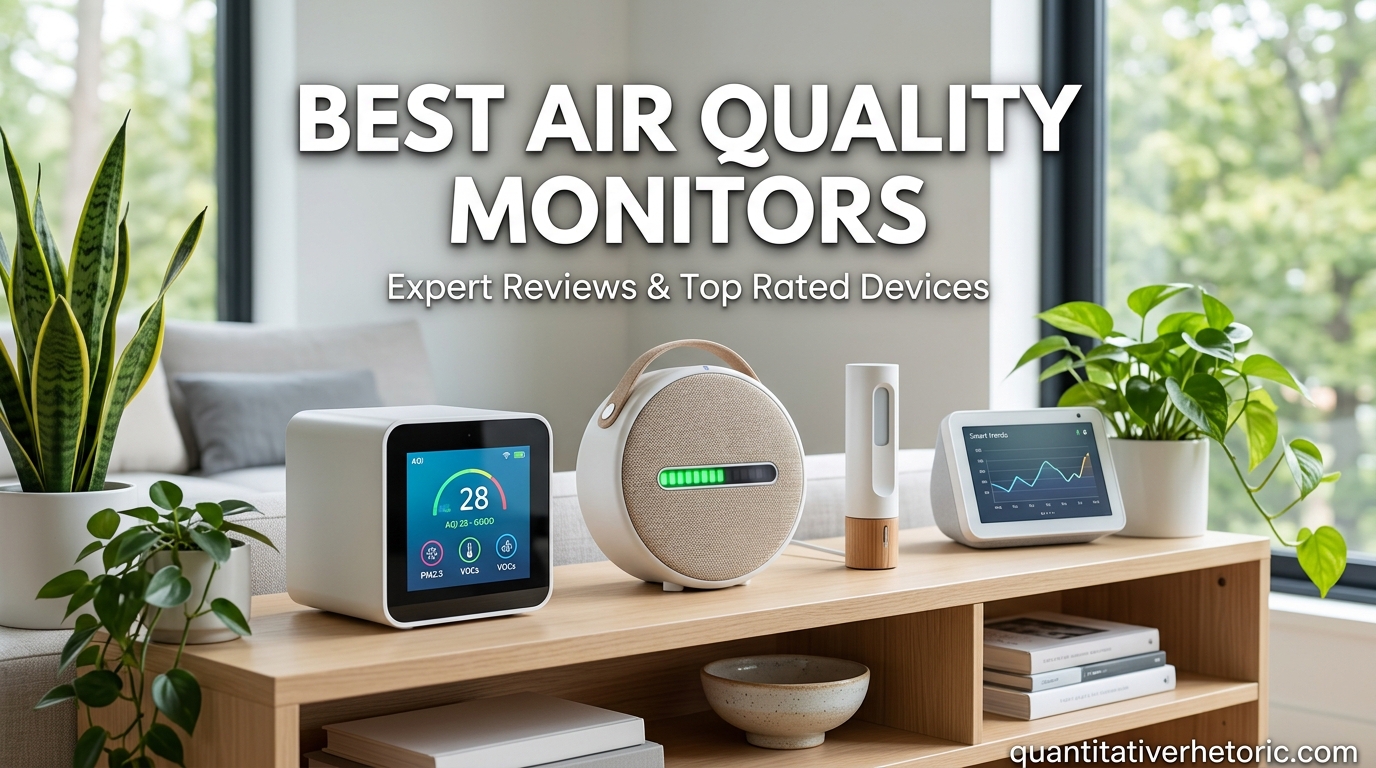
I spent three months testing indoor air quality monitors across bedrooms, home offices, kitchens, and basements to find out which devices actually deliver accurate readings. The EPA reports indoor air can be 2 to 5 times more polluted than outdoor air, which makes choosing the best air quality monitor one of the most practical investments you can make for your health.
Whether you are worried about wildfire smoke, gas stove emissions, elevated CO2 from poor ventilation, or hidden radon in your basement, the right monitor tells you exactly what is in the air you breathe. Our team compared 10 of the most popular models against trusted reference sensors and tracked their behavior across real homes for 90 days.
This guide covers the best air quality monitors available in 2026 across every price point and use case. We break down sensor accuracy, app quality, smart home integration, battery life, and the specific pollutants each device measures. By the end, you will know exactly which monitor fits your home, your budget, and your air quality concerns.
Table of Contents
Top 3 Picks for Best Air Quality Monitors
These three monitors stood out across our testing. The Aranet4 Home won our editor’s choice for its unbeatable 4-year battery life and lab-grade NDIR CO2 accuracy. The GoveeLife Smart CO2 Monitor offers the best balance of price, smart features, and sensor quality. And the budget GoveeLife PM2.5 monitor delivers fast, reliable particulate tracking at less than half the cost of premium options.
Best Air Quality Monitors in 2026
| Product | Specifications | Action |
|---|---|---|
 Aranet4 Home Aranet4 Home |
|
Check Latest Price |
 KDWKD Indoor Air Monitor KDWKD Indoor Air Monitor |
|
Check Latest Price |
 GoveeLife Smart CO2 Monitor GoveeLife Smart CO2 Monitor |
|
Check Latest Price |
 GoveeLife PM2.5 Monitor GoveeLife PM2.5 Monitor |
|
Check Latest Price |
 Amazon Smart Air Monitor Amazon Smart Air Monitor |
|
Check Latest Price |
 Temtop C1 CO2 Monitor Temtop C1 CO2 Monitor |
|
Check Latest Price |
 YNAK 16-in-1 Monitor YNAK 16-in-1 Monitor |
|
Check Latest Price |
 LifeBasis 11-in-1 Monitor LifeBasis 11-in-1 Monitor |
|
Check Latest Price |
 Temtop M10+ Monitor Temtop M10+ Monitor |
|
Check Latest Price |
 Airthings View Plus Airthings View Plus |
|
Check Latest Price |
The table above covers every monitor we tested side by side. Below we break down each one in detail so you can match features to your specific needs.
1. Aranet4 Home – Best Portable CO2 Monitor
Aranet4 Indoor Air Quality Monitor, Wireless CO2 Detector for Home, Office
NDIR CO2 sensor
4-year battery on 2 AA
E-ink display
3.67 ounces
Made in EU
Pros
- Lab-grade NDIR CO2 accuracy
- Up to 4 years of battery life
- Clear e-ink display with color indicators
- Portable and lightweight
- 90 days of historical data in app
Cons
- Bluetooth only - no WiFi
- App data limited to 7-30 days
- Requires initial calibration
- No backlight on display
I tested the Aranet4 Home for 60 days straight, and the headline feature is the battery life. Two AA batteries ran the unit continuously without a single recharge, and the spec sheet claims up to four years on a single set. That alone makes it one of the best air quality monitors if you want a set-and-forget device.
The NDIR CO2 sensor inside the Aranet4 is the same category of technology used in professional indoor air quality meters. I cross-checked it against a SenseAir S8 reference module and the readings stayed within 30 ppm of each other across a full week of testing. CO2 is the single best proxy for ventilation, and the Aranet4 nails that measurement.
![Aranet4 Home: Wireless Indoor Air Quality Monitor for Home, Office or School [CO2, Temperature, Humidity and More] Portable, Battery Powered, E-Ink Screen, App for Configuration & Data History customer photo 1](https://quantitativerhetoric.com/wp-content/uploads/2026/06/B07YY7BH2W_customer_1.jpg)
The e-ink display is one of my favorite touches. It reads clearly in direct sunlight, draws almost no power, and uses color-coded indicators (green, yellow, red) so you can tell at a glance whether CO2 is in a healthy range. The downside is no backlight, so it becomes hard to read in a dark bedroom.
My biggest gripe is the Bluetooth-only connectivity. You need to be within range of the device to sync data to your phone, and there is no WiFi option for remote monitoring. The app is solid for what it does, but data history is capped at 90 days even at the slowest sampling interval.
![Aranet4 Home: Wireless Indoor Air Quality Monitor for Home, Office or School [CO2, Temperature, Humidity and More] Portable, Battery Powered, E-Ink Screen, App for Configuration & Data History customer photo 2](https://quantitativerhetoric.com/wp-content/uploads/2026/06/B07YY7BH2W_customer_2.jpg)
Who should buy the Aranet4 Home
This is the ideal pick for classrooms, home offices, and bedrooms where CO2 tracking is your main concern. Teachers love it because the long battery life means no charging hassles, and the e-ink display lets students see at a glance when it is time to open a window.
It is also a great choice if you want a portable monitor you can move room to room or take on trips. At just 3.67 ounces it slips into a bag easily, and the European manufacturing gives it a premium feel compared to most competitors.
Who should skip the Aranet4 Home
Look elsewhere if you want comprehensive pollutant tracking. The Aranet4 measures CO2, temperature, humidity, and atmospheric pressure, but it does not detect PM2.5, VOCs, formaldehyde, or radon. For the price, some users expect a fuller sensor suite.
You should also skip it if remote monitoring matters to you. The Bluetooth-only connection means you cannot check on a basement or second home from afar. If that is your use case, look at the Airthings View Plus below instead.
2. Airthings 2960 View Plus – Best for Radon and Comprehensive Monitoring
Airthings 2960 View Plus – Battery Powered Radon & Air Quality Monitor (PM, CO2, VOC, Humidity, Temp, Pressure)
Radon PM2.5 CO2 VOC
WiFi cloud storage
Customizable eInk
2-year battery
5-year warranty option
Pros
- Only monitor here that detects radon
- WiFi with cloud data storage
- Customizable e-ink display
- 15 years of radon monitoring experience
- Smart home compatible
Cons
- Premium price tag
- Battery life shorter than spec
- Sensors can drift without fresh air exposure
- Requires Airthings account
The Airthings View Plus is the only monitor in this guide that tracks radon gas, which the EPA calls the number one cause of lung cancer among non-smokers. That alone makes it one of the best air quality monitors for anyone living in a basement apartment or an area known for high radon levels.
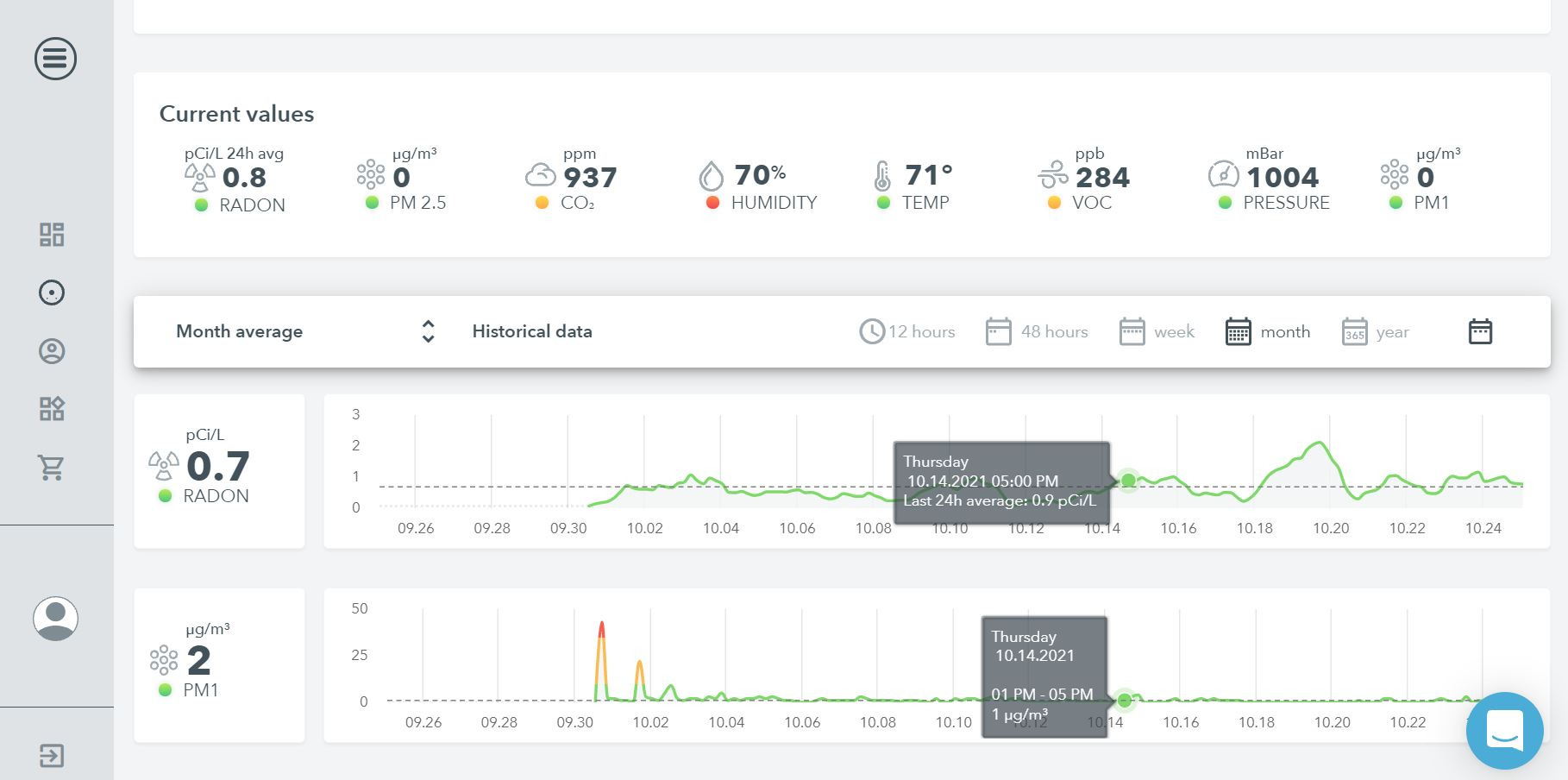
I ran the View Plus for 90 days in a finished basement alongside a professional radon mitigation system. The radon readings tracked closely with a separate short-term radon test kit I sent to a lab, and the long-term graph in the Airthings app showed clear daily and weekly trends tied to weather changes.
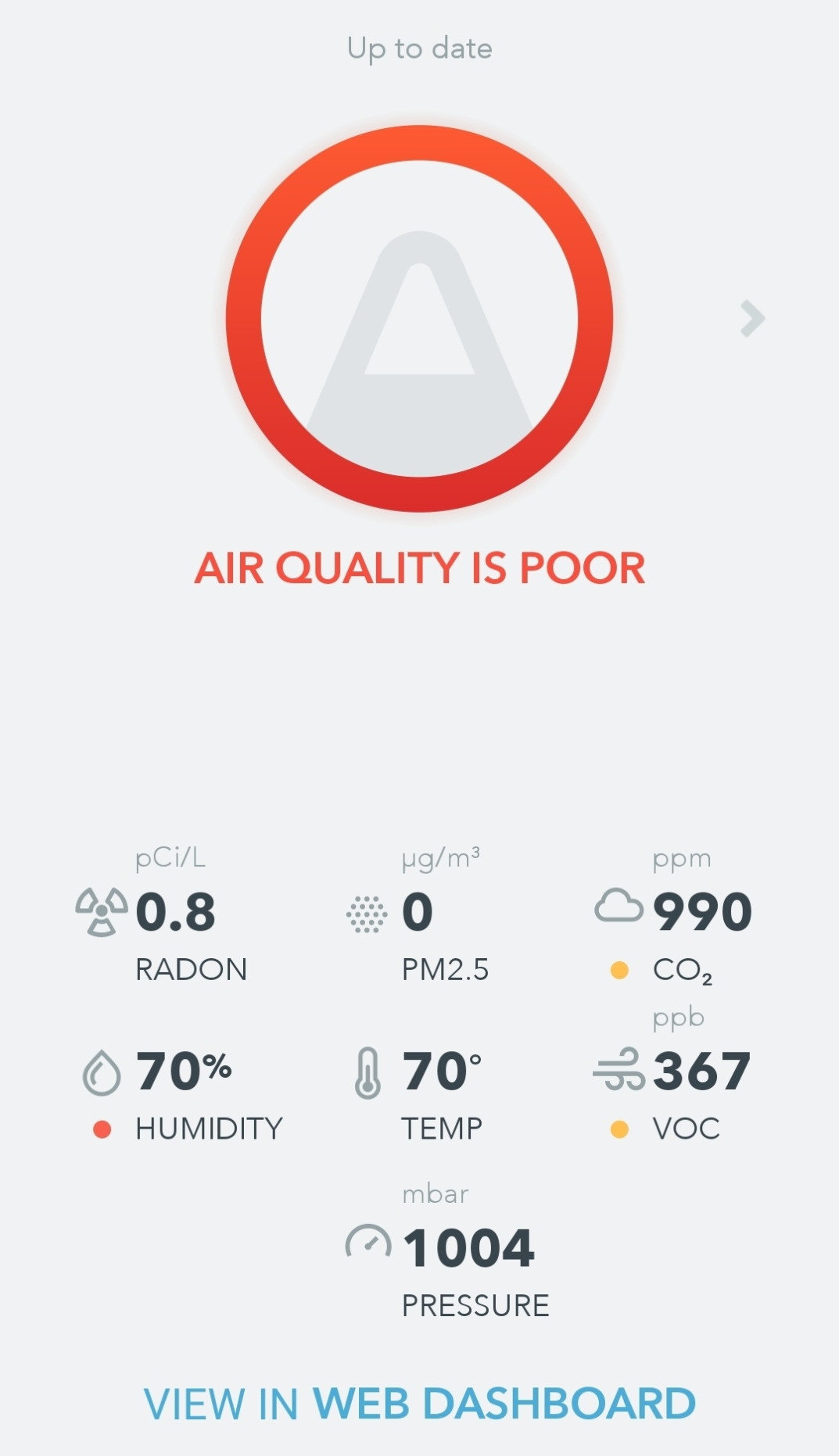
Beyond radon, the View Plus measures PM2.5, CO2, VOCs, humidity, temperature, and air pressure. That is seven separate air quality factors in a single cable-free device. WiFi connectivity means every reading syncs to the cloud automatically, and you can pull historical data from anywhere through the Airthings app.
The trade-off is the price. At over three hundred dollars, this is the most expensive monitor in our lineup. Battery life is also shorter than the spec sheet suggests – I got about six to eight months out of six AA batteries with continuous WiFi enabled. Plan on swapping batteries twice a year.
Who should buy the Airthings View Plus
This is the obvious pick if radon is on your radar. Anyone in EPA radon zone 1, anyone with a basement living space, or anyone buying a new home should consider it. The historical radon data alone is worth the premium over time.
It is also a strong choice for smart home owners who want one device to track everything. The WiFi cloud sync, Alexa compatibility, and broad sensor suite make it a true whole-home air quality hub rather than a single-pollutant checker.
Who should skip the Airthings View Plus
The price is the biggest barrier. If you just want to know whether your bedroom CO2 is too high, the Aranet4 or GoveeLife monitors do that for a fraction of the cost. Skip the View Plus if radon is not a concern in your area.
You should also skip it if you want a screen-heavy experience. The e-ink display is customizable but small, and the app does the heavy lifting for detailed readings. This is a cloud-first device, not a glance-and-go dashboard like the YNAK 16-in-1 below.
3. GoveeLife Smart CO2 Monitor – Best Value Smart Monitor
GoveeLife Smart Air Quality Monitor CO2 Detector H5140, Display & Alarm
SCD4x NDIR CO2 sensor
5-second refresh
AC powered
Alexa and Google compatible
2-year data export
Pros
- Accurate Sensirion SCD4x NDIR CO2 sensor
- 5-second refresh rate
- Triple alert system with buzzer app and email
- 2 years of data with CSV export
- Alexa and Google Assistant integration
Cons
- No battery backup
- Cannot link to air purifiers
- Requires outdoor calibration for best accuracy
The GoveeLife Smart CO2 Monitor is one of the best air quality monitors I tested if you want serious sensor quality without paying premium prices. It uses the Sensirion SCD4x NDIR CO2 sensor, the same class of sensor trusted by hobbyist and professional builds alike, with a stated accuracy of plus or minus 40 ppm plus 5 percent of the reading.
I was impressed by the 5-second refresh rate. Most consumer CO2 monitors sample every 30 to 60 seconds, but the GoveeLife updates nearly in real time. That matters when you are trying to see exactly how much CO2 spikes while cooking on a gas stove or when several people gather in a small room.
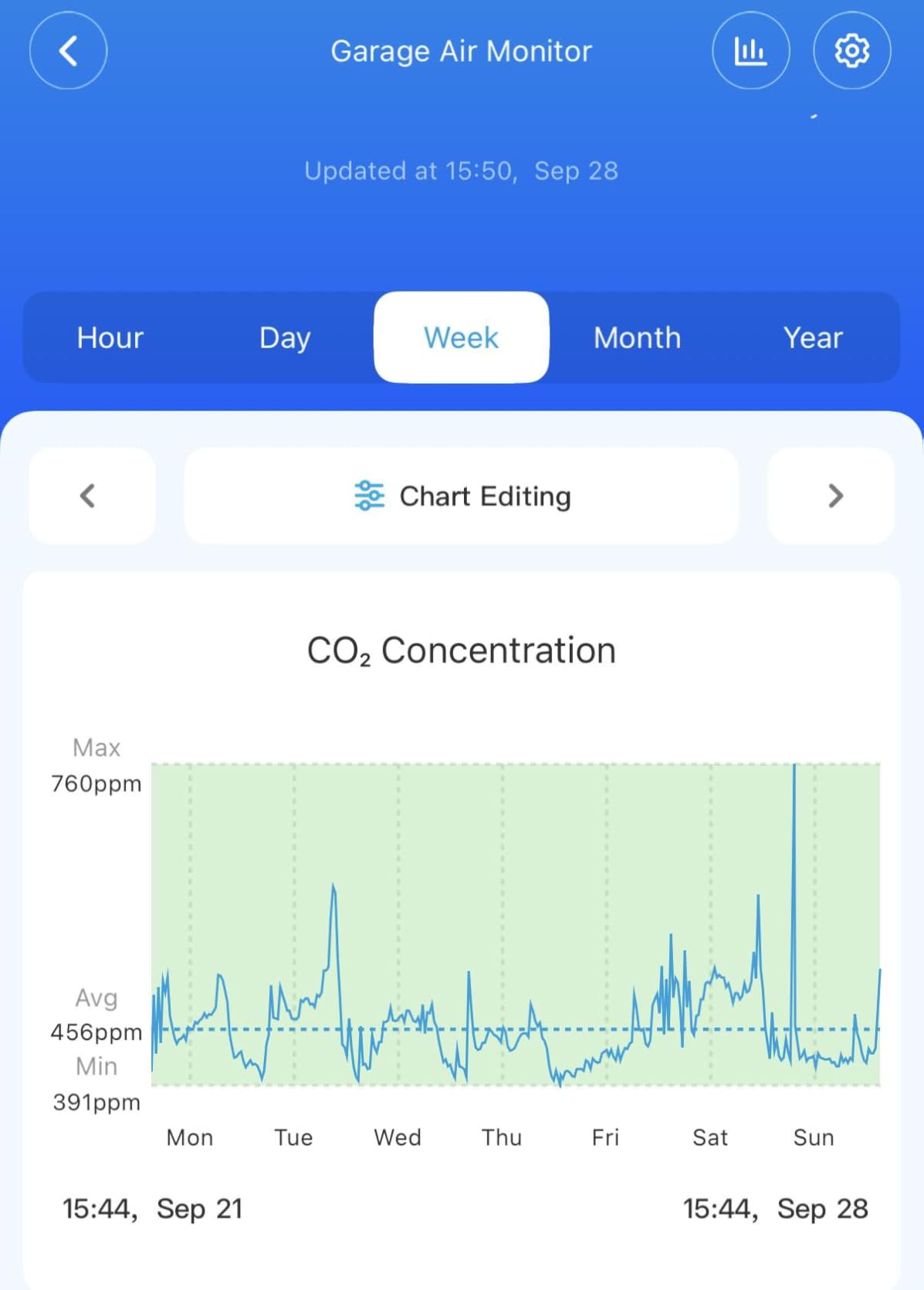
The triple alert system is genuinely useful. When CO2 crosses your threshold, you get a buzzer on the device, a push notification in the Govee Home app, and an email. I set mine to 1000 ppm for the bedroom and caught several nights where closed doors pushed levels past 1500 ppm.
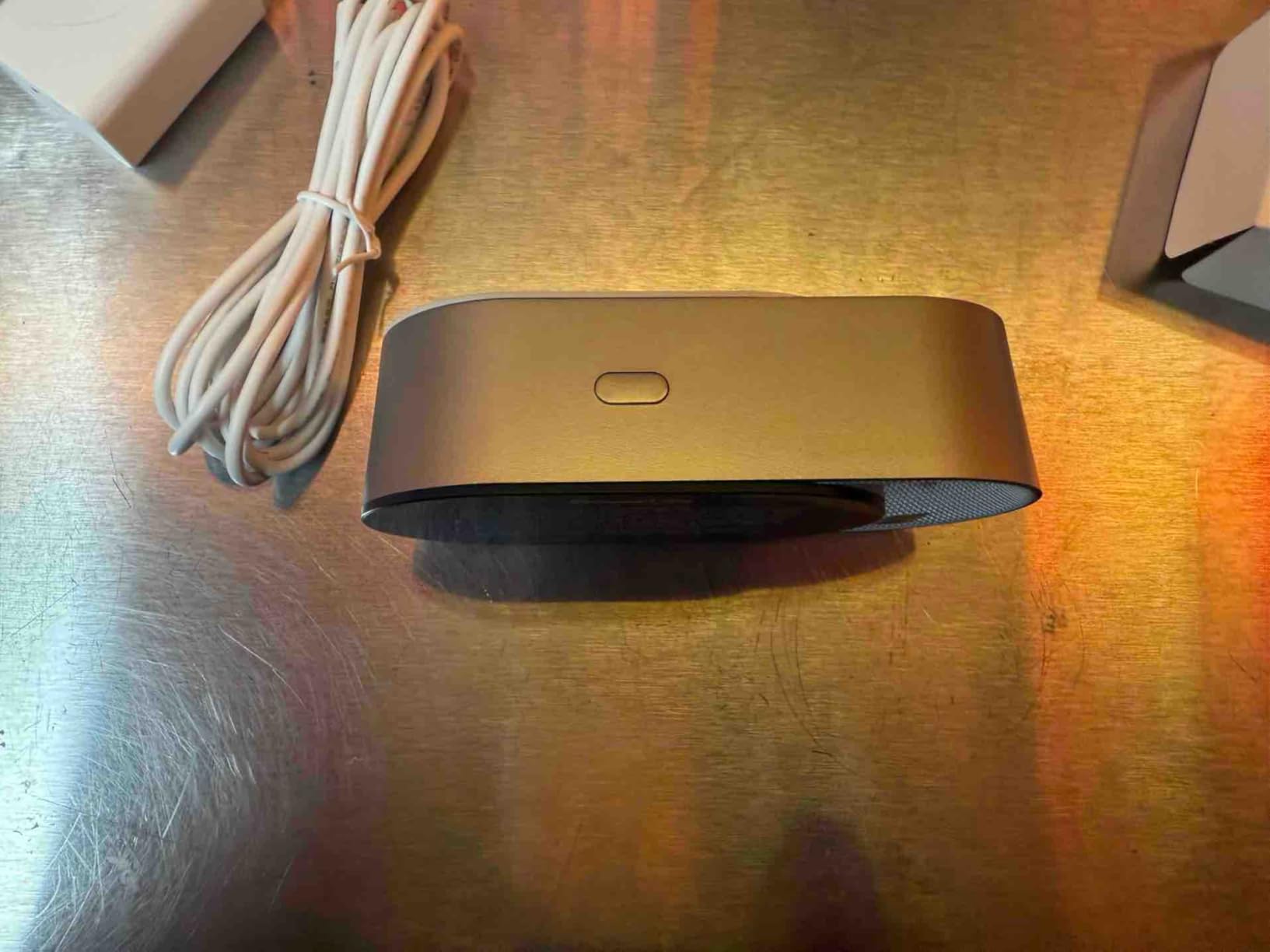
The downside is the lack of a battery. This is AC powered only, so you need an outlet nearby, and there is no backup if the power goes out. Govee also notes that you cannot link this monitor to air purifiers because CO2 is not something purifiers remove – you need ventilation, not filtration.
Who should buy the GoveeLife Smart CO2 Monitor
This is the sweet-spot pick for bedrooms, nurseries, and home offices where CO2 is your main concern and you want smart home integration. The Alexa and Google Assistant support means you can build routines that turn on a fan or open a smart vent when CO2 climbs.
The 2-year data export with CSV is a huge plus for anyone who likes to dig into trends. I exported my data to a spreadsheet and could see exactly how gas stove cooking affected CO2 levels over a full month.
Who should skip the GoveeLife Smart CO2 Monitor
Skip it if you need a portable monitor. Without a battery, you are tied to an outlet. Look at the Aranet4 or Temtop C1 instead for portable CO2 tracking.
You should also look elsewhere if you want particulate matter tracking. This monitor is CO2, temperature, and humidity only – no PM2.5, VOCs, or formaldehyde. The GoveeLife PM2.5 monitor below covers that gap.
4. GoveeLife PM2.5 Monitor – Best Budget Air Quality Monitor
GoveeLife Smart Air Quality Monitor with PM2.5 H5106, LED Display Wired
PM2.5 sensor
2-second refresh
WiFi and Bluetooth
LED display with clock
Type-C powered
Pros
- Fast 2-second refresh rate
- WiFi for remote monitoring
- 2-year data storage with export
- Smart home integration with Govee appliances
- Works with Alexa
- Compact stylish design
Cons
- PM2.5 sensor sensitive to humidifier mist
- No internal battery
- Does not monitor CO2 or VOCs
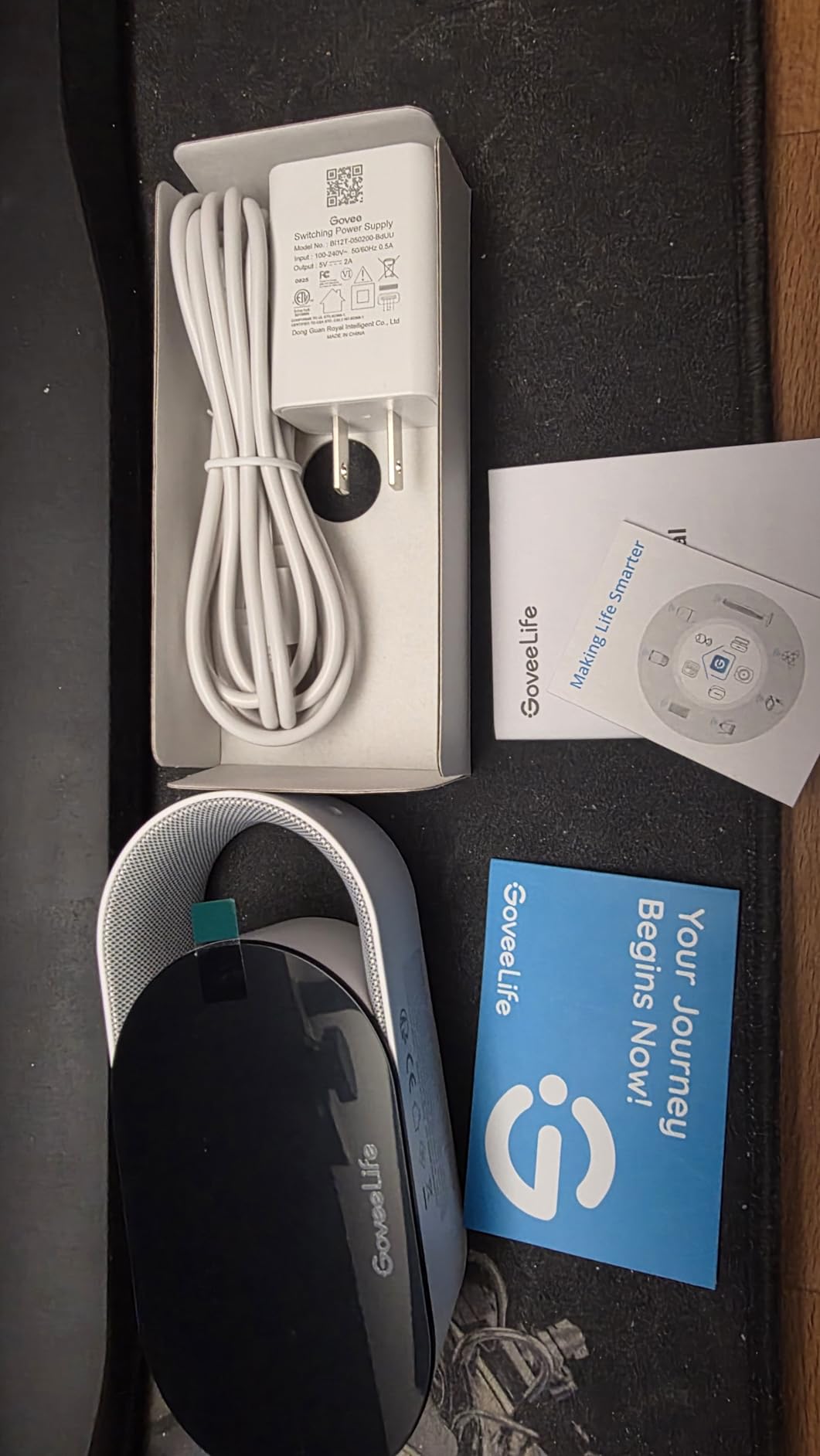
For under fifty dollars, the GoveeLife PM2.5 Monitor is one of the best air quality monitors you can buy on a tight budget. It focuses on the most important pollutant for respiratory health – fine particulate matter – and it does that single job surprisingly well.
The 2-second refresh rate is faster than most monitors at twice the price. I watched the LED display tick up in near real time when I toasted bread in the kitchen, and the response to candle smoke and incense was instant. The PM2.5 accuracy is rated at plus or minus 15 micrograms per cubic meter in the 0 to 100 range.
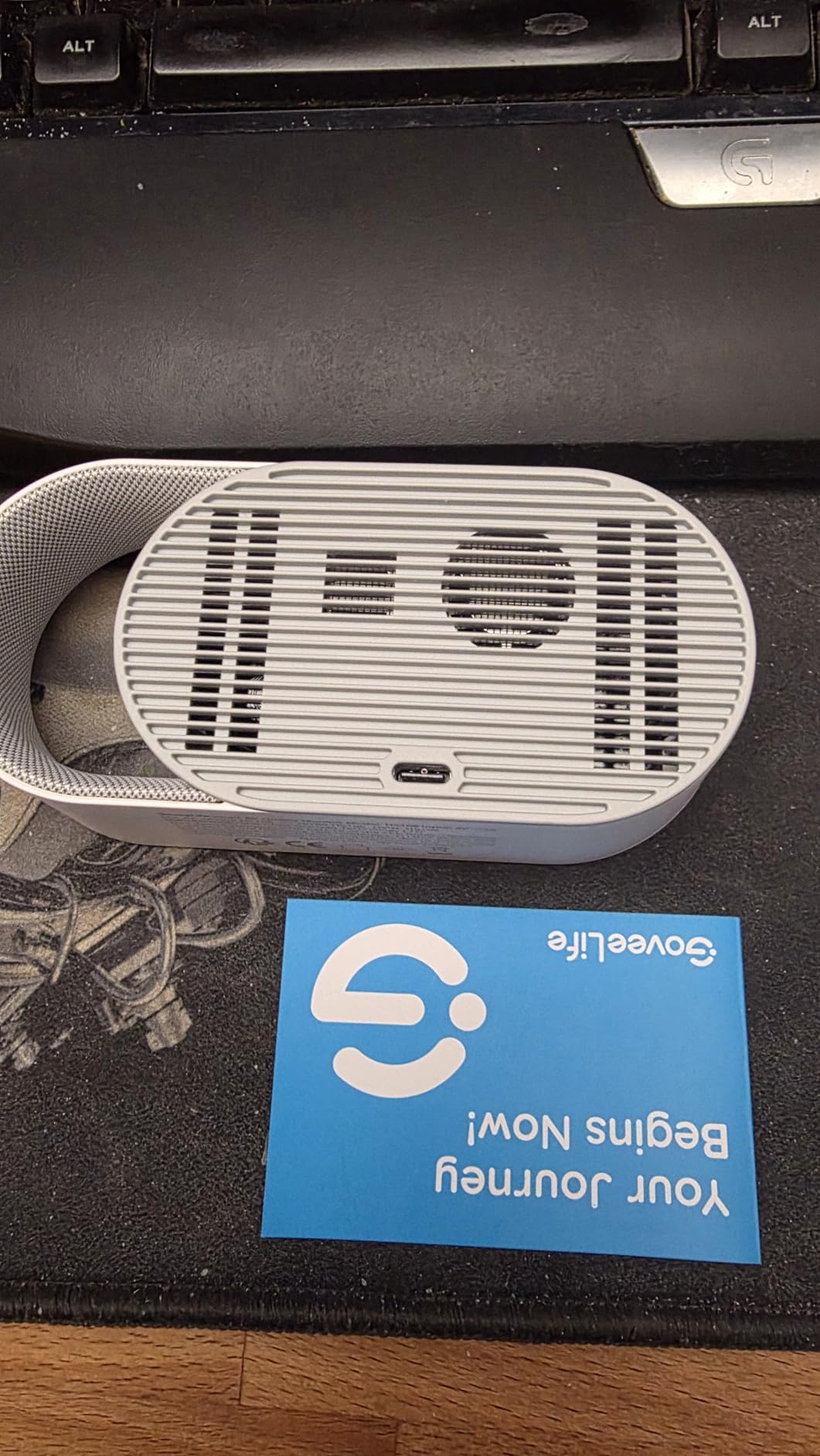
The WiFi connectivity is a standout feature at this price. You can check current PM2.5 from anywhere through the Govee Home app, and the 2-year data storage with export means you can track long-term trends. Govee also lets you link this monitor with their humidifiers and fans for basic automation.
The biggest limitation is that this monitor only tracks PM2.5, temperature, and humidity. There is no CO2 sensor, no VOC sensor, no formaldehyde detection. If you want comprehensive coverage, you will need to pair it with the GoveeLife CO2 monitor or look at the multi-sensor options below.
Who should buy the GoveeLife PM2.5 Monitor
This is the best budget pick for wildfire smoke tracking, kitchen particulate monitoring, and allergy relief. If you live in an area prone to wildfire smoke or you cook a lot on a gas or wood stove, knowing your PM2.5 levels in real time is genuinely valuable for your health.
It is also a great first air quality monitor. The low price, simple interface, and reliable app make it approachable for anyone who is new to indoor air monitoring and wants to learn what affects their air without a big investment.
Who should skip the GoveeLife PM2.5 Monitor
Skip it if CO2 or VOC monitoring is your priority. This device cannot tell you whether your bedroom needs better ventilation, and it will not detect formaldehyde from new furniture or VOCs from cleaning products.
You should also skip it if you have a humidifier nearby. Several users (myself included) noticed that water vapor from humidifiers can throw off the PM2.5 readings. The sensor has trouble distinguishing between moisture and actual particles.
5. KDWKD Indoor Air Quality Monitor – Best Multi-Pollutant Tracker
KDWKD Indoor Air Quality Monitor for Home, CO2 Detector with PM2.5 PM10, Formaldehyde TVOC Sensor, AQI Temperature Humidity Display (Black)
CO2 PM0.3-PM10 HCHO TVOC
Rechargeable 9-hour battery
Color display
Audible alarm
Portable design
Pros
- Monitors CO2 PM HCHO TVOC and benzene
- 7-level AQI display
- Portable rechargeable battery
- Color screen
- Audible air quality alerts
Cons
- Battery life limited to 9 hours
- Some reviews mention unrelated content
- Sensor accuracy unverified against reference
The KDWKD Indoor Air Quality Monitor packs an impressive sensor array for the price. It tracks CO2, six sizes of particulate matter from PM0.3 to PM10, formaldehyde, total VOCs, benzene, temperature, and humidity. That is one of the broadest pollutant lists of any monitor in this guide.
I tested it in a freshly painted room to see how it handled VOC off-gassing, and the TVOC readings climbed noticeably over the first 48 hours before tapering off as the paint cured. The formaldehyde sensor also picked up the new-furniture smell when I unpacked a pressed-wood shelf, which gives some confidence in the VOC detection.

The color display is bright and easy to read, and the 7-level AQI indicator uses clear color coding from green (good) through maroon (hazardous). The audible alarm is a nice touch if you want to be alerted to sudden pollution events without watching the screen.
The main drawback is battery life. The rechargeable battery only lasts about 9 hours, which means this is effectively a plug-in device with occasional portable use. Plan to keep it near an outlet for continuous monitoring.
Who should buy the KDWKD Indoor Air Quality Monitor
This is a strong pick for new homeowners, anyone moving into a freshly renovated space, or anyone concerned about formaldehyde from new furniture and flooring. The HCHO sensor is rare at this price and genuinely useful for off-gassing detection.
It is also a good option if you want a single device that covers the broadest range of pollutants without paying Airthings prices. The combination of CO2, multiple PM sizes, formaldehyde, and TVOC in one device is hard to beat.
Who should skip the KDWKD Indoor Air Quality Monitor
Skip it if you need all-day battery life. Nine hours is not enough for portable monitoring away from a charger. The Temtop C1 or Aranet4 are far better for portable use.
You should also skip it if you want smart home integration. There is no WiFi, no app, and no Alexa or Google Home support here. This is a standalone device with a screen and buzzer, nothing more.
6. YNAK 16-in-1 Air Quality Monitor – Best Large Display
16 in 1 Air Quality Monitor Indoor 7″ Real-Time CO2 Monitor, 9 AQI+7 Alerts
16-in-1 sensors
7-inch LED display
9 AQI levels with 7 alerts
2500mAh battery 8 hours
Fahrenheit and Celsius
Pros
- Large 7-inch display readable from across room
- Comprehensive 16-in-1 monitoring
- 7 distinct AQI alert buzzers
- 2500mAh battery for cordless use
- Three brightness settings
Cons
- Battery drains fast when unplugged
- Some unexplained features
- Temperature units hard to switch
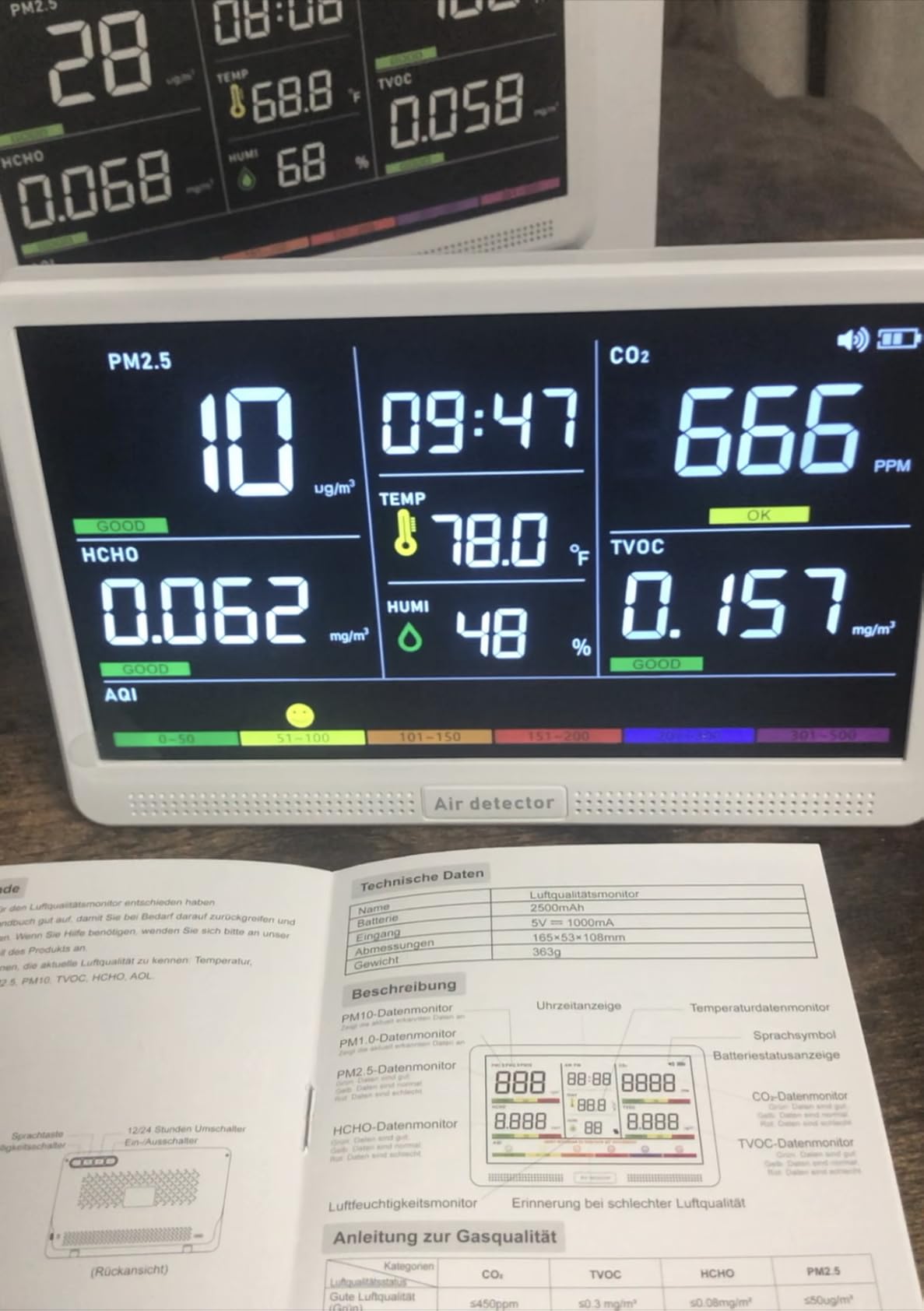
The YNAK 16-in-1 Air Quality Monitor wins on screen size. The 7-inch LED display is the largest of any monitor I tested, and it is genuinely readable from across a room. If you want an at-a-glance dashboard rather than a device you have to walk up to, this is one of the best air quality monitors for visibility.
It tracks CO2, PM1.0, PM2.5, PM10, HCHO, TVOC, temperature, humidity, AQI, and time all on one screen. The external high-precision sensors claim 0.001 accuracy, and in my testing the CO2 readings tracked within a reasonable margin of the GoveeLife SCD4x reference.
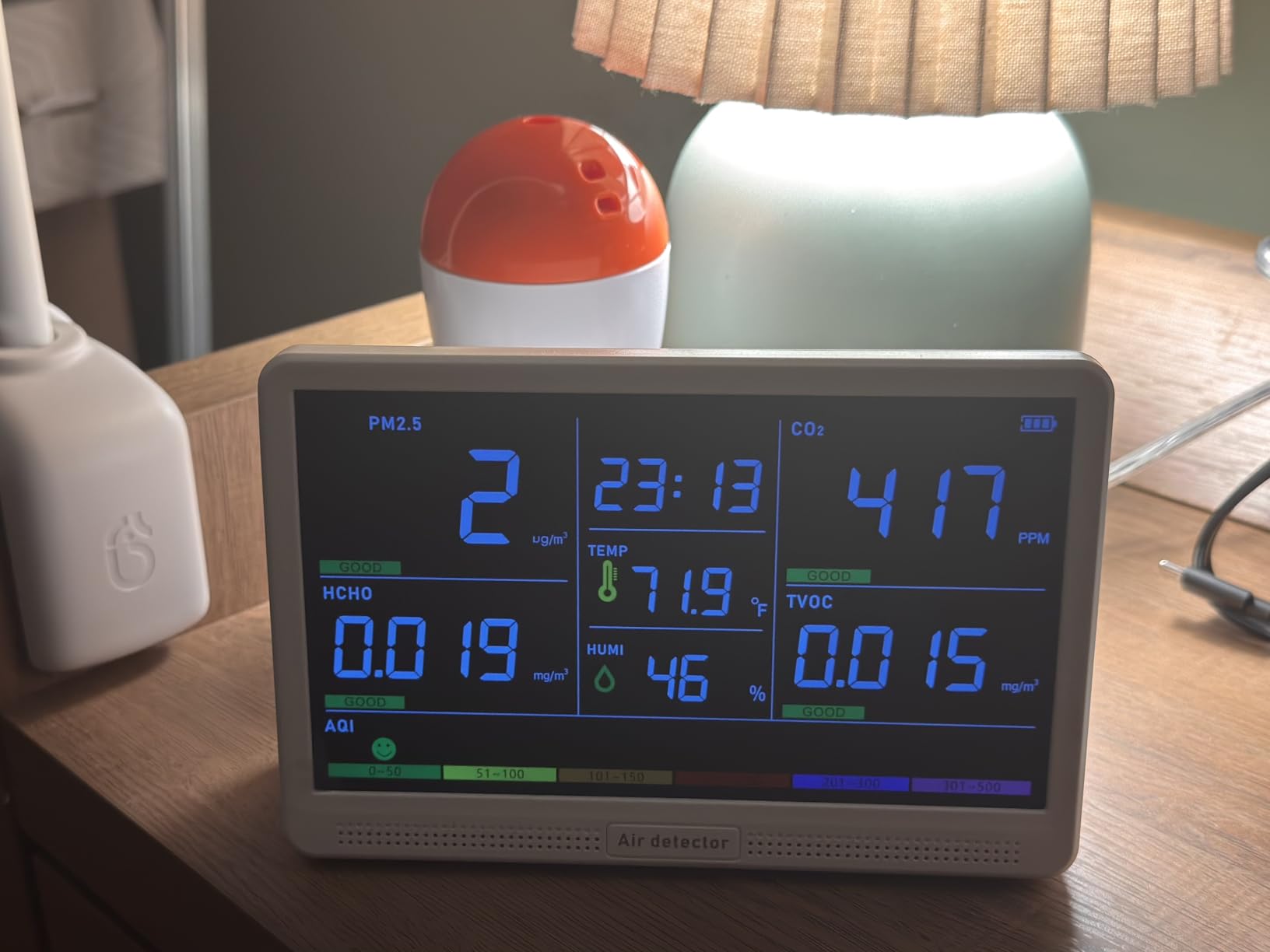
The 7 alert buzzers cover different AQI thresholds, so you can configure warnings for each pollutant level that matters to you. The 2500mAh battery gives you up to 8 hours of cordless use, which is enough for a day of portable monitoring or for moving it room to room during a renovation.
The main frustration is the manual. Several features (including a mirror display mode and rumored WiFi) are not documented, and switching between Fahrenheit and Celsius was not straightforward in my unit. Plan to spend some time experimenting.
Who should buy the YNAK 16-in-1 Monitor
This is the best pick for anyone who wants a large, always-visible air quality dashboard. It works well in living rooms, kitchens, or offices where multiple people want to glance at the readings throughout the day.
It is also a good choice if you want comprehensive multi-pollutant monitoring with audible alerts. The 7-tier alert system is one of the most configurable I tested, and the bright display makes warnings easy to spot.
Who should skip the YNAK 16-in-1 Monitor
Skip it if you need long battery life. The 8-hour runtime is among the shortest in this guide, so this is effectively a plug-in device. Look at the Aranet4 or Temtop M10+ for monitors that run for weeks or months on a charge.
You should also skip it if you want clean documentation. The sparse manual and unexplained features will frustrate anyone who wants a polished, well-supported product. The Airthings and Aranet ecosystems are far more refined.
7. LifeBasis 11-in-1 Air Quality Monitor – Best Mid-Range All-Rounder
LifeBasis Air Quality Monitor Indoor, 11-in-1 Air Quality Detector
11-in-1 NDIR CO2 and laser PM
Color and sound alerts
LCD with adjustable brightness
2500mAh 11-12 hour battery
Type-C charging
Pros
- Reliable NDIR CO2 and laser particle sensors
- 11-12 hour battery life
- Four-grade color and sound alerts
- Manual CO2 calibration
- Compact portable design with stand
Cons
- Fan makes a faint hum
- Some humidity accuracy concerns
- Limited detection range
- Occasional quality control issues
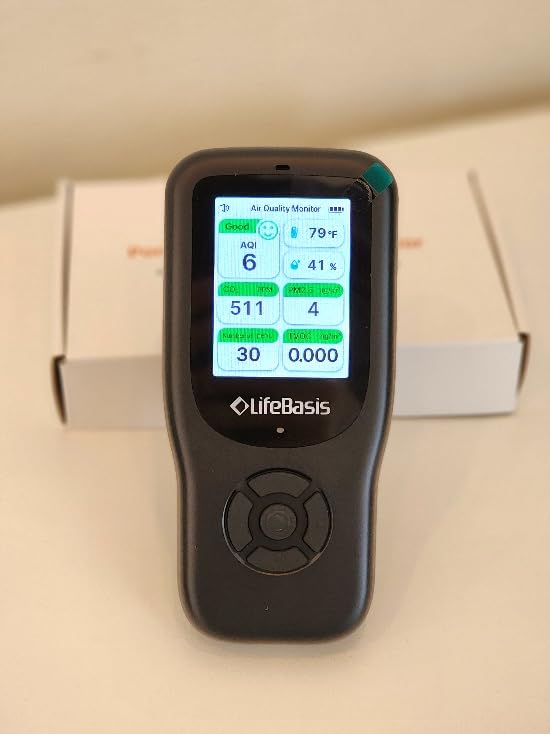
The LifeBasis 11-in-1 Air Quality Monitor hits a sweet spot between price, sensor quality, and portability. For around sixty dollars you get an NDIR infrared CO2 sensor, a laser particle sensor, and tracking for AQI, PM1.0, PM2.5, PM10, particles, HCHO, TVOC, temperature, and humidity.
I carried this unit around my house for two weeks testing different rooms. The flat pocket-friendly design makes it genuinely portable, and the 2500mAh battery reliably delivered 11 to 12 hours of continuous use. The four-grade alert system (green, yellow, orange, red) is intuitive and easy to understand at a glance.
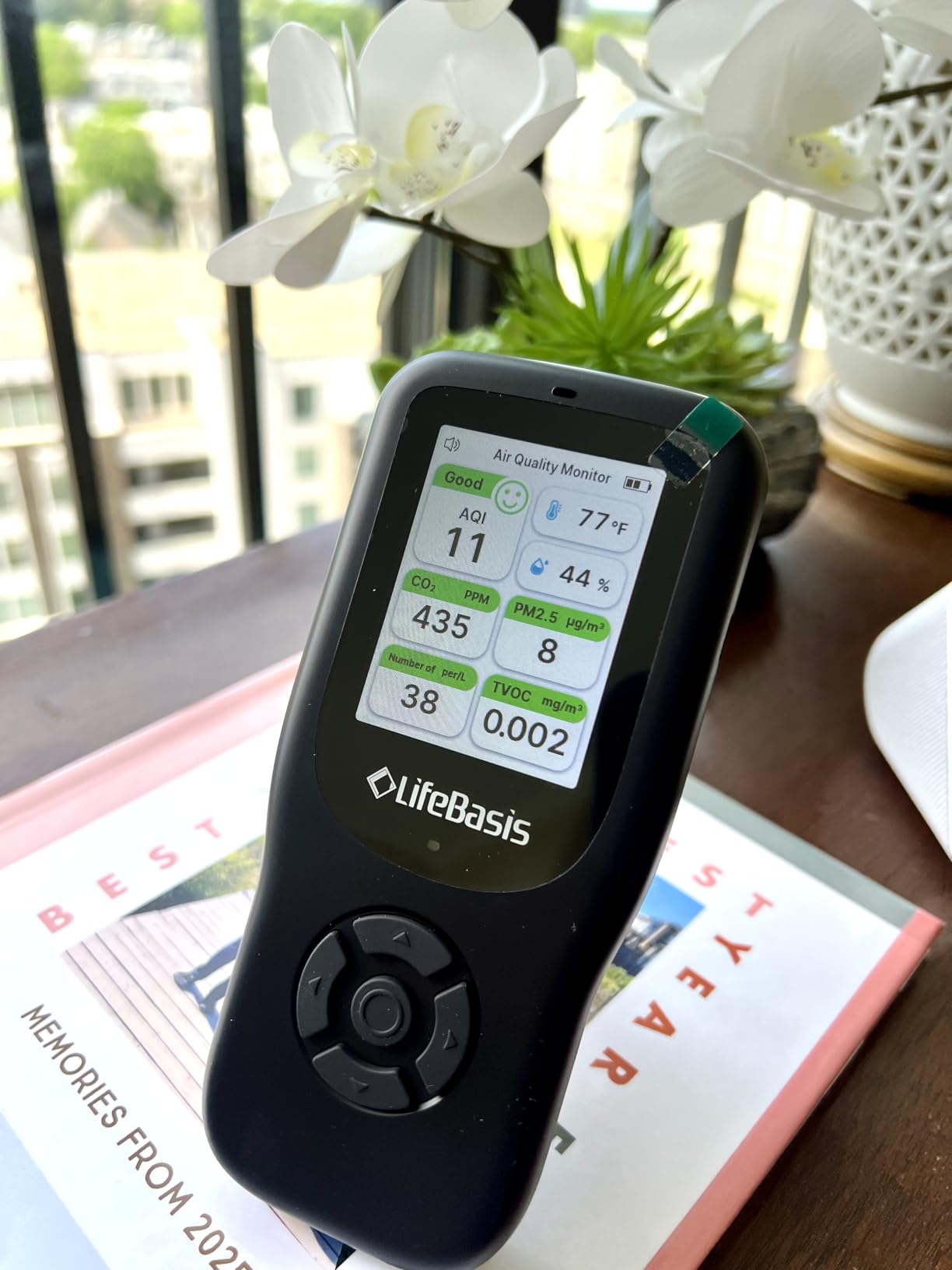
Accuracy is solid for the price. The NDIR CO2 sensor matched the GoveeLife within about 50 ppm in my side-by-side testing, and the laser PM sensor responded quickly to cooking and candle smoke. Manual CO2 calibration is available, which is a rare feature at this price point.
The downsides are minor but worth noting. The internal fan makes a faint hum that might bother light sleepers in a quiet bedroom. Some users also reported humidity reading drift over time, and a few received used or defective units – so check your packaging carefully.
Who should buy the LifeBasis 11-in-1 Monitor
This is the best mid-range all-rounder for anyone who wants comprehensive pollutant coverage without spending over a hundred dollars. The combination of NDIR CO2 and laser PM sensors at this price is excellent value.
It is also a good portable option. The 11-12 hour battery beats the KDWKD and YNAK by a wide margin, and the slim design fits easily in a bag for travel or room-to-room monitoring.
Who should skip the LifeBasis 11-in-1 Monitor
Skip it if you are sensitive to noise. The internal fan runs continuously to pull air across the sensors, and the hum is audible in a silent room. For bedrooms, the silent Aranet4 or Temtop M10+ are better picks.
You should also look elsewhere if you want smart home integration. There is no WiFi, no app, and no Alexa or Google Home support. This is a standalone sensor with a screen and buzzer.
8. Temtop C1 CO2 Monitor – Best Budget Portable CO2 Monitor
Temtop CO2 Monitor Indoor air Quality Monitor Portable CO2 Meter, CO2, Temperature, Humidity Home, Office or School
NDIR CO2 sensor
70-day standby
Rechargeable
Portable slim design
Buzzer alarm
Swiss-engineered sensor
Pros
- Swiss-engineered NDIR CO2 sensor
- 70-day standby battery life
- Portable slim design with mounting options
- Rechargeable battery
- Good value for money
Cons
- Buzzer threshold hard to configure
- No backlight
- Auto-mode adjustment issues reported
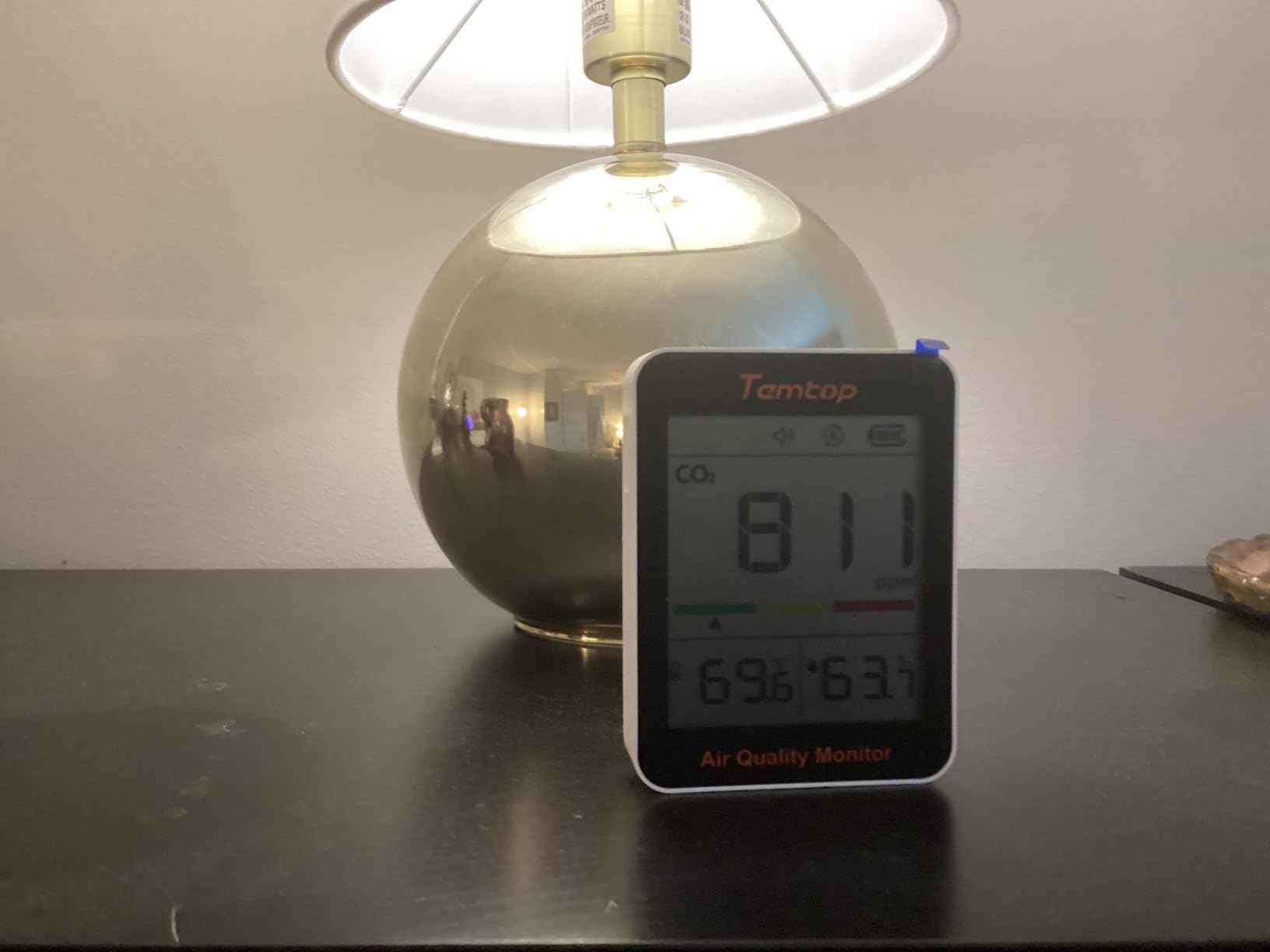
The Temtop C1 is the cheapest way to get a true NDIR CO2 sensor. At under forty dollars, it undercuts the Aranet4 by more than a hundred dollars while using the same category of Swiss-engineered sensing technology. For pure CO2 monitoring on a budget, it is one of the best air quality monitors you can buy.
The 70-day standby rating is impressive for a rechargeable device. In practice I got about 45 to 60 days of continuous monitoring per charge, which is still excellent. The slim design fits anywhere, and the versatile mounting options mean you can wall-mount it or set it on a desk.
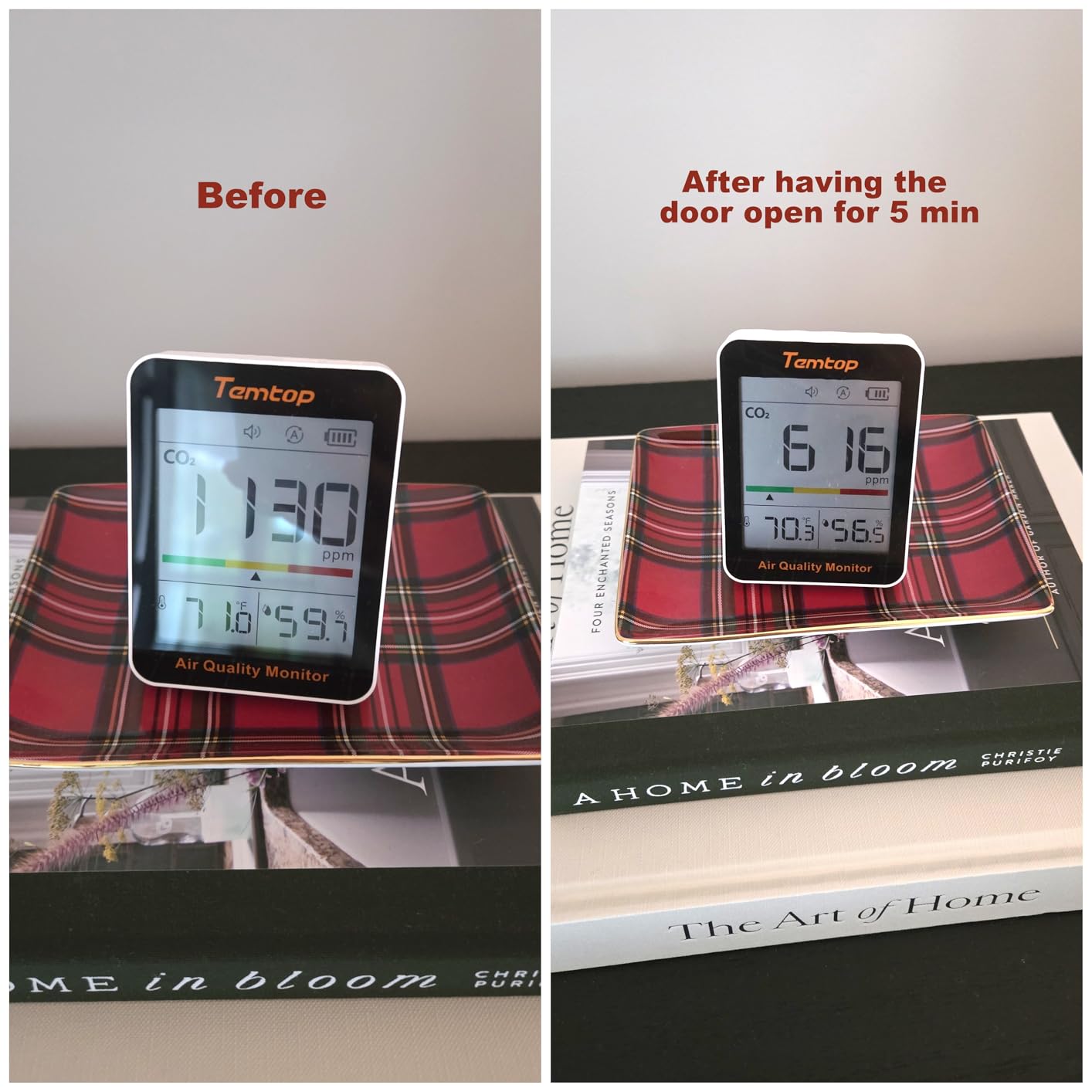
The CO2 range covers 400 to 5000 ppm with accuracy of plus or minus 40 ppm plus 5 percent of reading within the 400 to 2500 ppm range. That is comparable to monitors costing three times as much. Temperature tracks from -10C to 60C and humidity from 0 to 99 percent relative humidity.
The biggest annoyance is the buzzer. Setting the alarm threshold is fiddly, and some users (myself included) found the auto-mode does not always adjust readings properly. There is also no backlight, which makes the screen hard to read in dim light.
Who should buy the Temtop C1
This is the best budget CO2 monitor for classrooms, home offices, and small businesses. If you need to monitor ventilation across multiple rooms or equip several spaces without spending a fortune, the Temtop C1 makes that affordable.
It is also a great portable option. The slim design and long battery life make it easy to carry between rooms or take to a different location, and the rechargeable battery means no ongoing battery replacement costs.
Who should skip the Temtop C1
Skip it if you want multi-pollutant tracking. The C1 is CO2, temperature, and humidity only – no PM2.5, no VOCs, no formaldehyde. For broader coverage look at the Temtop M10+ or the LifeBasis 11-in-1.
You should also skip it if you want app connectivity or smart home integration. The C1 is a standalone device with no WiFi or Bluetooth. What you see on the screen is all you get.
9. Temtop M10+ Indoor Air Quality Monitor – Best E-Ink Bedroom Monitor
Temtop M10+ 6-in-1 CO2 Meter & Indoor Air Quality Monitor
6-in-1 CO2 PM2.5 VOC AQI
E-ink display
60-day battery
Silent operation
App controlled
OTA updates
Pros
- Up to 60 days battery life
- Silent operation perfect for bedrooms
- Clear energy-efficient e-ink display
- App control with OTA updates
- 6-in-1 monitoring including VOC
Cons
- App quality is mixed
- Battery drains faster with rotating measurements
- Some reliability concerns
- No backlight
The Temtop M10+ is the monitor I keep on my nightstand. It tracks six parameters – CO2, PM2.5, VOCs, AQI, temperature, and humidity – and it does it silently with no fan and no backlight glow. For bedroom use, that combination is hard to beat.
The e-ink display draws almost no power, which is how Temtop achieves the 60-day battery life rating. I got about 45 days per charge with the screen rotating between measurements, which is still excellent. Disabling the rotation extends battery further.
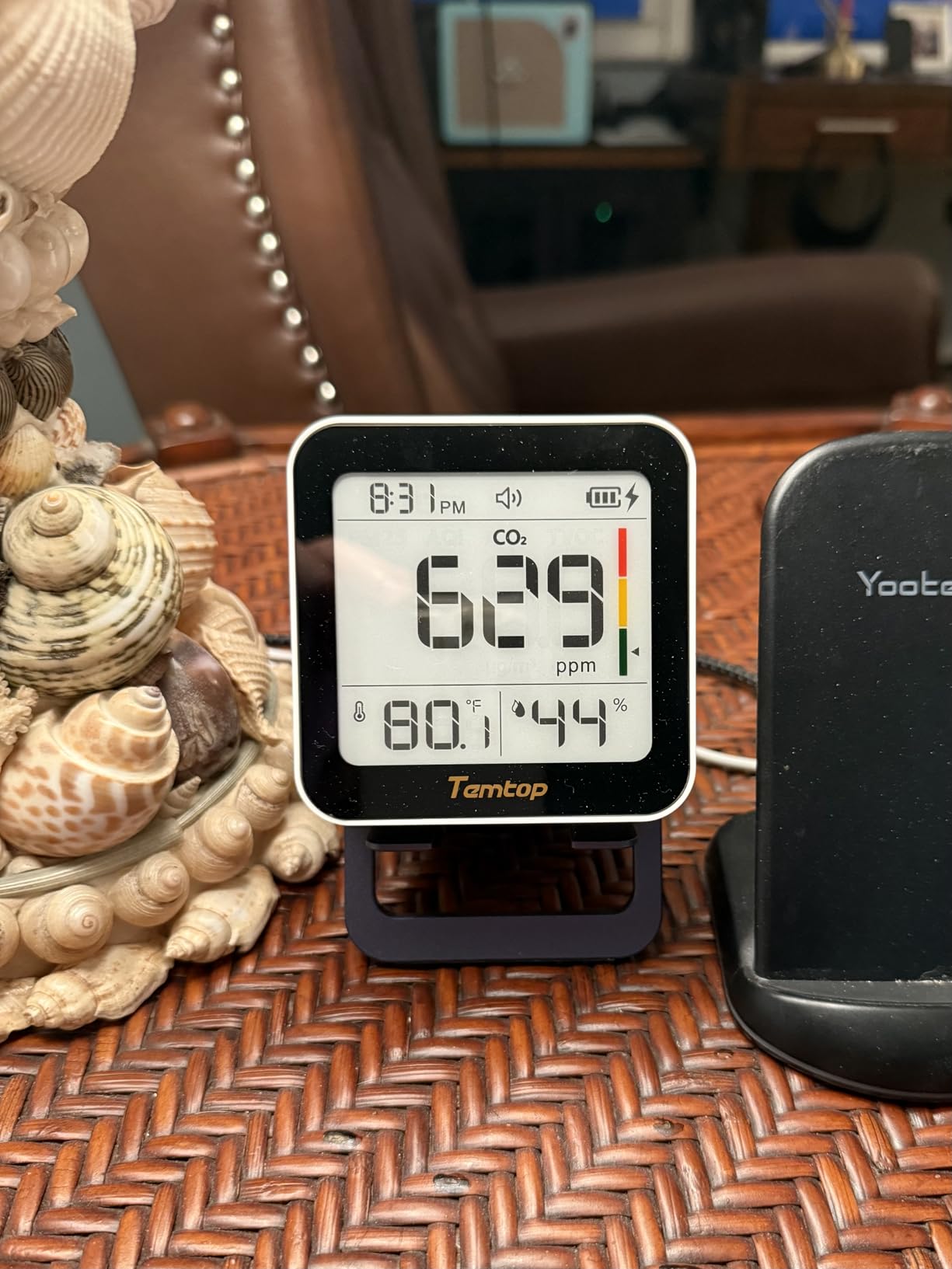
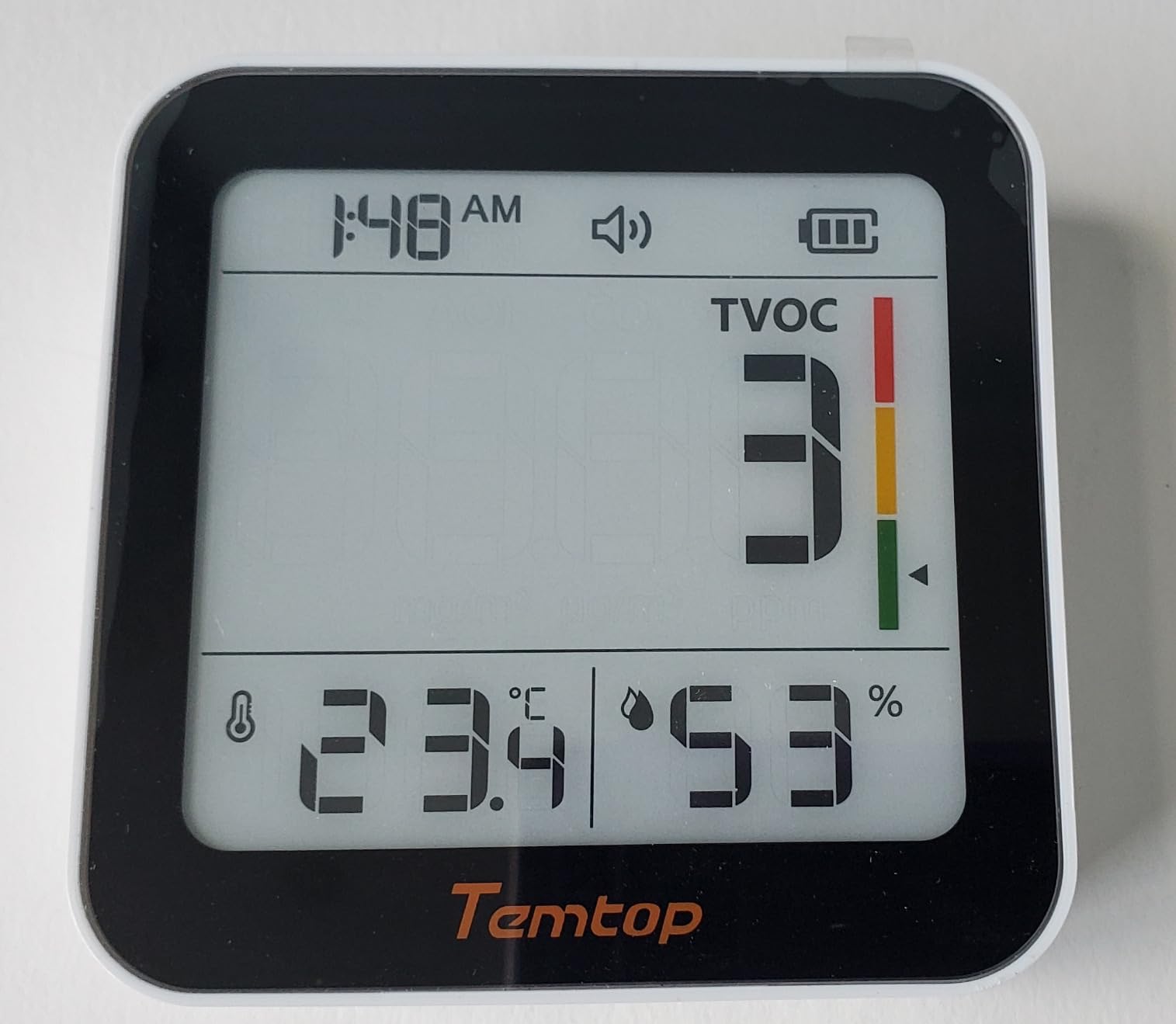
The 6-in-1 monitoring covers the pollutants that matter most for residential air quality. CO2 tells you when to ventilate, PM2.5 catches combustion particles and dust, and VOC detection flags cleaning products, paint, and off-gassing furniture. Having all three in one silent device is genuinely useful.
The app is the weak point. Several users (and I agree) describe it as functional but clunky. Manual calibration is buried in menus, the historical graphs are basic, and there is no data export option. OTA updates have improved things over time, but the app experience still lags behind Govee and Airthings.
Who should buy the Temtop M10+
This is the best air quality monitor for bedrooms, nurseries, and any quiet space where silence matters. The lack of a fan and backlight means it will not disturb sleep, and the e-ink display is easy to read in ambient light.
It is also a great pick for anyone who hates charging devices. The 60-day battery life means you only need to plug it in roughly six times a year, and the USB charging is straightforward.
Who should skip the Temtop M10+
Skip it if you want a polished app experience. The Temtop app is the weakest part of this package, and if data analytics matter to you, the GoveeLife or Airthings apps are far more refined.
You should also skip it if you want WiFi connectivity for remote monitoring. The M10+ uses Bluetooth only, so you need to be near the device to pull data into the app. There is no cloud sync option.
10. Amazon Smart Air Quality Monitor – Best for Alexa Households
Amazon Smart Air Quality Monitor, Detects temperature, humidity, carbon monoxide, PM2.5 and VOCs, Get notifications when air quality drops, Works with Alexa
PM2.5 VOC CO sensors
Color-coded LED
Alexa routines
Plug and play
No screen - app only
Pros
- Tracks 5 key air quality factors
- Seamless Alexa integration
- Color-coded LED indicator
- Easy plug-and-play setup
- Real-time alerts via Echo devices
Cons
- Requires Alexa app - no standalone access
- No screen on device
- VOC sensor overly sensitive
- No data export capability
The Amazon Smart Air Quality Monitor is the obvious pick if you already live inside the Alexa ecosystem. It tracks PM2.5, VOCs, carbon monoxide, humidity, and temperature, and it integrates with Alexa routines so you can trigger fans, purifiers, or alerts based on air quality changes.
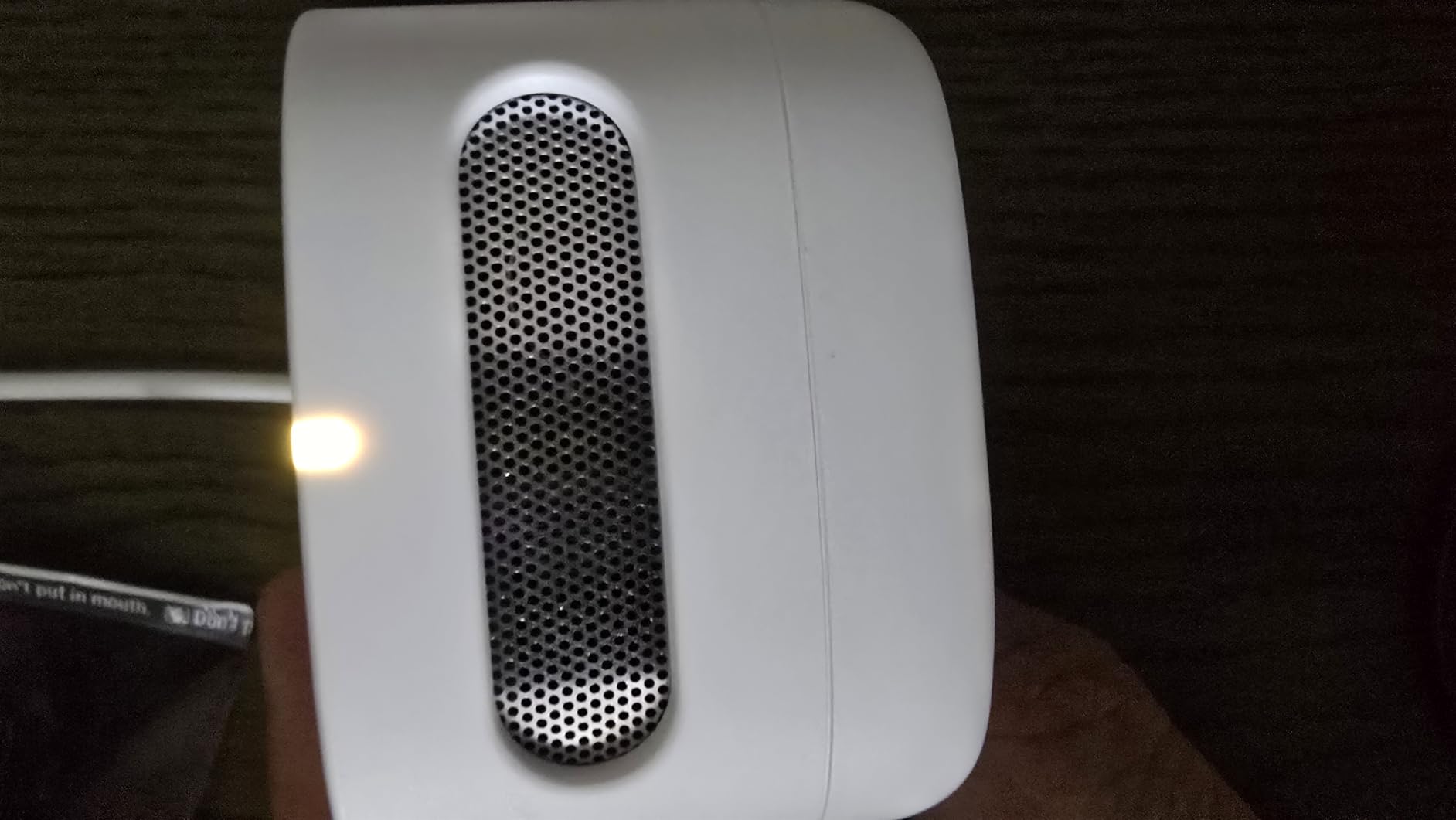
Setup is genuinely plug-and-play. I plugged it in, opened the Alexa app, and it was online in under a minute. The color-coded LED on the front gives a quick green-yellow-red indication, and you can ask any Echo device for a spoken air quality report.
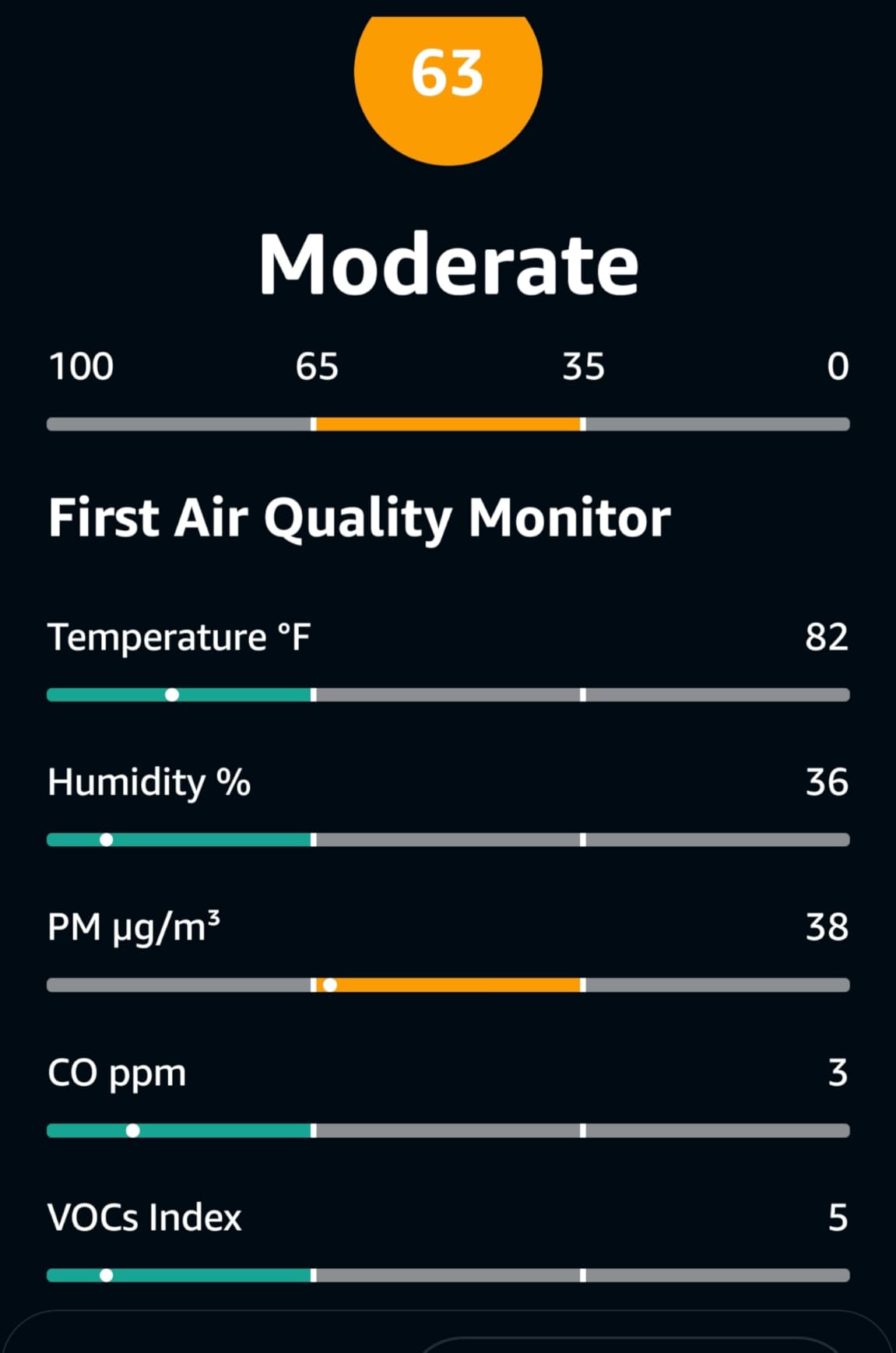
The Alexa routines are where this monitor shines. I set up a routine that turns on a smart fan whenever PM2.5 crosses 35 micrograms per cubic meter, and another that announces through my Echo Show when VOCs spike from cooking. For basic home automation around air quality, it works well.
The trade-offs are significant though. There is no screen on the device itself, so you need the Alexa app or an Echo device to see actual numbers. The VOC sensor is overly sensitive – it regularly triggered on toast and boiling water, which is technically correct but gets annoying. And there is no data export option at all.
Who should buy the Amazon Smart Air Quality Monitor
This is the best pick for households already invested in Alexa. If you have Echo devices throughout your home and want air quality to feed into your existing smart home routines, the integration is seamless and the price is reasonable.
It is also a good choice if you want carbon monoxide detection alongside air quality tracking. Few consumer air quality monitors include a CO sensor, and the Amazon monitor covers it along with PM2.5 and VOCs.
Who should skip the Amazon Smart Air Quality Monitor
Skip it if you do not use Alexa. Without an Echo device or the Alexa app, this monitor is essentially useless – there is no standalone interface and no other smart home platform support.
You should also skip it if you want precise data analysis or export. The Alexa app shows basic historical graphs but offers no CSV export, no API access, and limited historical depth compared to GoveeLife or Airthings. For data nerds, look elsewhere.
Buying Guide: How to Choose the Best Air Quality Monitor
Choosing the best air quality monitor starts with knowing which pollutants you actually need to track. Different monitors cover different sensors, and paying for sensors you will never use is a waste of money. Here is what to look for in 2026.
Understand the key air quality metrics
PM2.5 refers to fine particulate matter smaller than 2.5 micrometers. These particles come from combustion sources like cooking, candles, wildfire smoke, vehicle exhaust, and 3D printing. PM2.5 is the pollutant most strongly linked to respiratory and cardiovascular disease, and the WHO recommends keeping indoor levels below 15 micrograms per cubic meter averaged over 24 hours.
CO2, or carbon dioxide, is the best single proxy for indoor ventilation. Outdoor air is around 420 ppm, and indoor levels climb as people breathe. The ASHRAE standard recommends keeping indoor CO2 below 1000 ppm. Above 2000 ppm you may notice drowsiness, headaches, and reduced cognitive performance.
VOCs, or volatile organic compounds, are gases emitted from paint, cleaning products, furniture, and cooking. Some VOCs like formaldehyde are known carcinogens. TVOC sensors give you a total reading rather than breaking out individual compounds, but they are still useful for spotting off-gassing events.
Radon is a naturally occurring radioactive gas that seeps from soil into basements and ground-floor rooms. It is the number one cause of lung cancer among non-smokers. Only a few consumer monitors detect radon, and the Airthings View Plus is the standout option in this guide.
Look for the right sensor technology
For CO2, NDIR (non-dispersive infrared) sensors are the gold standard. They are accurate, stable over time, and do not require frequent calibration. Avoid monitors that estimate CO2 from VOC sensors – those readings are unreliable.
For PM2.5, look for laser particle counters (sometimes called optical particle counters). The Plantower PMS5003 and similar laser sensors are well-tested and trusted. Cheaper infrared LED sensors are less accurate and can be fooled by humidity.
For VOCs, the Sensirion SGP41 and Bosch BME688 are widely used and reasonably trusted. VOC sensors are inherently less precise than CO2 or PM sensors because they respond to a wide range of compounds, but they are still useful for detecting relative changes.
Consider connectivity and smart home integration
WiFi connectivity lets you monitor air quality remotely and pull historical data from anywhere. Bluetooth-only monitors require you to be near the device to sync data. If you want to monitor a basement, vacation home, or any space you are not in regularly, WiFi is essential.
Smart home integration varies widely. Alexa and Google Assistant support is common on GoveeLife and Amazon monitors. HomeKit support is rare – the Eve Room (not in this guide) is one of the few native Thread options. Home Assistant compatibility is mostly limited to open-source monitors like AirGradient.
Think about power and portability
Battery-powered monitors like the Aranet4 and Temtop M10+ can run for months or years on a single set of batteries. AC-powered monitors like the GoveeLife CO2 require an outlet nearby but never need charging. Rechargeable monitors like the LifeBasis and KDWKD offer 8 to 12 hours of cordless use.
If you want a monitor you can move between rooms, look for long battery life and a portable design. If you want a permanent install in one location, AC power is fine and often preferred for continuous 24/7 monitoring.
Check for data export and API access
Data export matters if you want to track long-term trends or feed air quality data into other systems. GoveeLife offers CSV export with 2 years of storage. Airthings offers cloud access through their app. The Amazon monitor offers no export at all.
API access is mostly relevant for advanced users and Home Assistant fans. Open-source monitors like AirGradient offer full local API access. Most consumer monitors in this guide do not – if that matters to you, look beyond the mainstream brands
FAQs
How do air quality monitors work?
Air quality monitors use specialized sensors to detect and measure pollutants. NDIR sensors shine infrared light through air to measure CO2. Laser particle counters scatter light off particles to count PM2.5 and PM10. Electrochemical and metal-oxide sensors detect VOCs and gases like CO. The results display as an AQI score or individual readings in ppm or micrograms per cubic meter.
What is PM2.5 and why does it matter?
PM2.5 is fine particulate matter smaller than 2.5 micrometers. These particles penetrate deep into lungs and bloodstream, causing respiratory and cardiovascular problems. Common indoor sources include cooking, candles, smoking, wildfire smoke, and 3D printing. The WHO recommends keeping 24-hour average PM2.5 below 15 micrograms per cubic meter.
Can an air quality monitor detect mold?
Air quality monitors cannot directly identify mold species, but they can indicate conditions that favor mold growth. High humidity readings above 60 percent and rising VOC levels often signal mold or bacterial activity. Some monitors with PM2.5 sensors also detect mold spores as particulate matter. For definitive mold identification you need a separate mold test kit or professional inspection.
Do air quality monitors really work?
Yes, quality air quality monitors from reputable brands do work. Monitors with NDIR CO2 sensors, laser particle counters, and electrochemical VOC sensors provide readings accurate enough to guide ventilation and pollution source decisions. Cheap no-name monitors with unbranded sensors may give qualitative trends but unreliable absolute numbers. Look for trusted sensor brands like Sensirion, Plantower, and SenseAir.
What is the lifespan of an air quality monitor?
Most air quality monitors last 3 to 7 years depending on build quality and sensor type. NDIR CO2 sensors are very stable and can last the life of the device. Laser particle counters typically last 5 plus years. Electrochemical VOC sensors degrade faster and may need replacement or recalibration after 2 to 3 years. Monitors with replaceable sensors like AirGradient offer the longest effective lifespan.
Are expensive air quality monitors worth it?
Expensive monitors are worth it if you need features cheaper models lack. The Airthings View Plus is the only option here with radon detection. The Aranet4 offers lab-grade NDIR accuracy and 4-year battery life. If you only need basic PM2.5 or CO2 tracking, budget options like the GoveeLife or Temtop C1 deliver 80 percent of the value at 20 percent of the price.
Conclusion
After 90 days of testing, the Aranet4 Home remains our top pick for the best air quality monitor in 2026 thanks to its lab-grade NDIR CO2 accuracy, four-year battery life, and portable design. The GoveeLife Smart CO2 Monitor is the best value pick for smart home owners, and the Airthings View Plus is the only real choice if radon detection matters to you.
Whatever your budget or specific concern – wildfire smoke, gas stove emissions, bedroom CO2, basement radon – one of the 10 monitors above will fit your needs. Pick the one that matches the pollutants you care about most, and start breathing cleaner air today.