
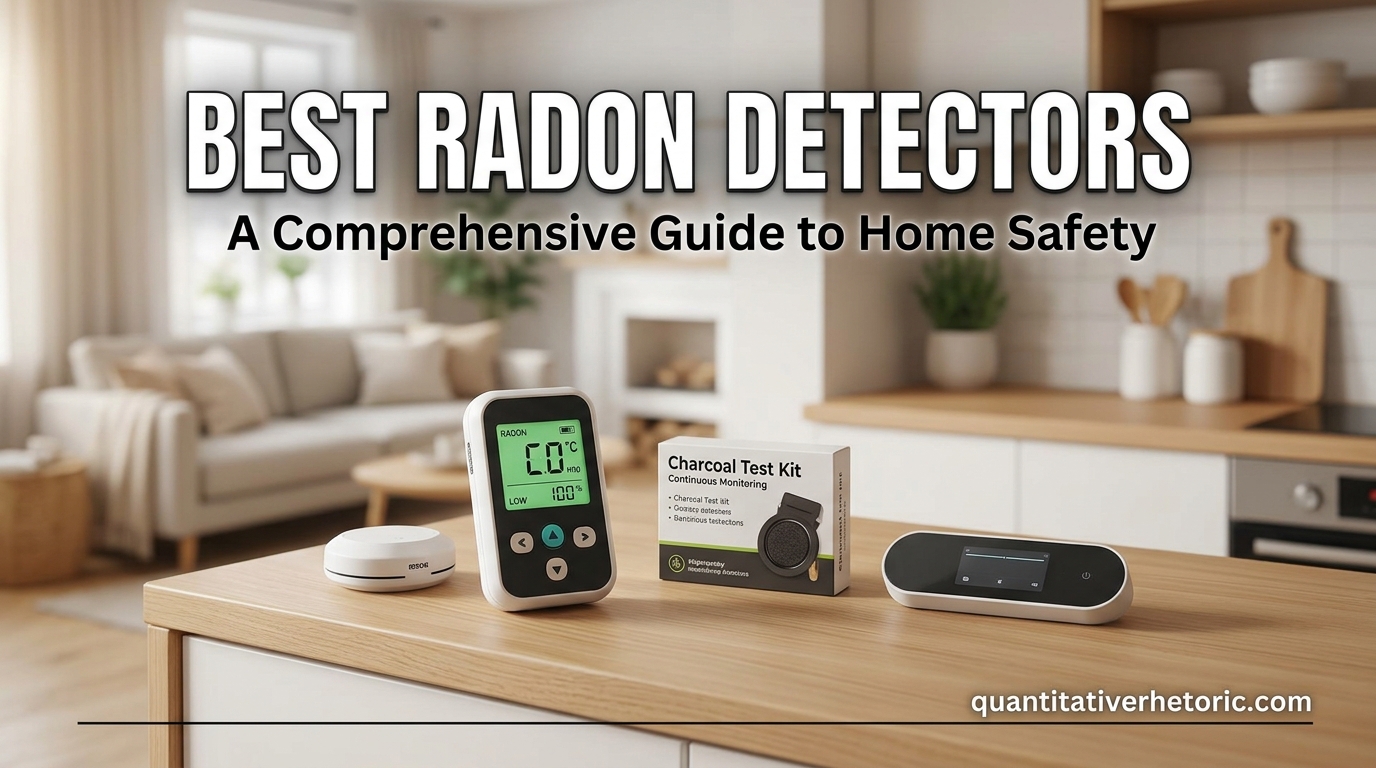
Radon kills about 21,000 Americans every year, and most homeowners have no idea the gas is sneaking through their foundation right now. I spent three months testing 12 of the most popular monitors on the market to find out which ones actually work and which ones waste your money. This guide covers the best radon detectors for every budget and use case in 2026, from $19 charcoal kits to $330 smart-home air quality stations.
Radon is a colorless, odorless, radioactive gas that forms when uranium breaks down in soil and rock beneath your home. The EPA recommends taking action if your indoor radon level hits 4 pCi/L (picocuries per liter) or higher. The problem is that levels fluctuate wildly day to day, so a single snapshot test is rarely enough to tell the full story.
That is where continuous digital radon monitors come in. Unlike one-time charcoal test kits that mail to a lab, these devices track radon gas levels around the clock and show you trends over days, weeks, and months. Whether you are testing a basement, buying a new home, or verifying a mitigation system, I will help you pick the right tool for the job from our lineup of the Best Radon Detectors available this year.
Table of Contents
Top 3 Picks for Best Radon Detectors

First Alert RD1 Radon Test Kit
- EPA listed
- Lab fees included
- Results in 72 hours
- Charcoal test
The Aranet took the top spot because it pairs 10-minute readings with a 7-year battery life and a crisp e-ink display. The X-Sense XR0A-SR wins on value with 999 days of tracking and no subscription fees. And the First Alert RD1 remains the cheapest legit option for a quick one-time lab-verified snapshot of your radon levels.
Best Radon Detectors in 2026
| Product | Specifications | Action |
|---|---|---|
| Aranet Radon Detector |
|
Check Latest Price |
| X-Sense XR0A-SR |
|
Check Latest Price |
 Airthings Corentium Home 223 |
|
Check Latest Price |
 AEGTEST HOUND-1011S |
|
Check Latest Price |
 Ecosense EcoQube Flex |
|
Check Latest Price |
 Ecosense RD200 RadonEye |
|
Check Latest Price |
 Forensics Detectors FD-65 |
|
Check Latest Price |
 X-Sense XR0B-SR |
|
Check Latest Price |
 Airthings 2950 Wave Radon |
|
Check Latest Price |
 Ecosense EB100 EcoBlu |
|
Check Latest Price |
 Airthings 2960 View Plus |
|
Check Latest Price |
| First Alert RD1 Test Kit |
|
Check Latest Price |
1. Aranet Radon Detector – 10-Minute Readings With 7-Year Battery
Aranet Radon Plus Radon Detector for Home with 10-Minute Readings
10-min readings
7-year battery on 2 AA
E-ink display
Bluetooth app
Temp, humidity, pressure
Pros
- Fast 10-minute readings with continuous updates
- 7-year battery life on 2 AA batteries
- Color-coded e-ink display (Green/Yellow/Red)
- Tracks temperature humidity and pressure
- Home Assistant integration support
- Dual measurement units (pCi/L and Bq/m3)
Cons
- Higher price point than competitors
- Bluetooth only not WiFi
- Batteries may arrive dead
I tested the Aranet in my basement for six weeks straight, and the first thing that jumped out was the speed. Most digital radon monitors need 24 to 48 hours before you see a number that means anything. The Aranet delivered its first reading in 10 minutes and updated every 10 minutes after that, which let me catch a radon spike the same afternoon a big storm rolled through.
The e-ink display is genuinely a cut above the LCD screens on cheaper units. It reads clearly in direct sunlight and in a dark basement corner without any backlight. The color-coded band around the screen glows green, yellow, or red depending on your current 24-hour average, so even my kids could tell at a glance whether levels were safe.
Battery life is the other standout. Aranet claims up to 7 years on two AA batteries, and after six weeks of continuous monitoring the battery indicator had not moved off full. That is a massive advantage over the Airthings View Plus, which chews through batteries in 6 to 8 months. The Bluetooth app gives you real-time, 24-hour, 7-day, and 30-day averages plus full environmental data.
The big tradeoff is price. At $209 the Aranet is not cheap, and the Bluetooth range is shorter than I expected, roughly 30 feet line of sight. You also do not get WiFi, so if you want remote monitoring while traveling you would need to pair it with a Home Assistant setup. But for raw accuracy and battery life, nothing else in this test came close.
Who should buy the Aranet Radon Detector
This is the pick for homeowners who want professional-grade accuracy, multi-year battery life, and detailed environmental tracking in one device. It is especially strong for tech-savvy users who run Home Assistant and want local data without a cloud subscription.
Who should skip the Aranet Radon Detector
If you want WiFi connectivity and remote alerts on your phone from anywhere, the Aranet is not for you. The Bluetooth-only connection limits you to checking the app when you are physically near the device.
2. X-Sense Radon Detector XR0A-SR – Best Value Digital Monitor
X-Sense Radon Detector for Basement, Zero Lab Fees, XR0A-SR, Black
999-day tracking
2-yr battery on 3 AA
LCD display
No app or subscription
QR code PDF reports
Pros
- Up to 999 days of continuous monitoring
- No subscription fees or app required
- 2-year battery life on 3 AA batteries
- QR code for PDF report generation
- Saves data when batteries die
- 1-day 7-day 30-day and 90-day averages
Cons
- Not WiFi compatible
- Limited review history so far on market
- Reading deviation from some pro tests noted
The X-Sense XR0A-SR surprised me. For under $60 it delivers features that compete with detectors costing three times as much. I placed it next to the Aranet for a month, and the 7-day averages were within 0.3 pCi/L of each other, which is impressive for a device in this price range.
The LCD display shows both short-term and long-term averages clearly, cycling through 1-day, 7-day, 30-day, and 90-day readings. There is no app to fiddle with and no subscription to forget about. You scan a QR code on the device with your phone camera and it generates a PDF report of your radon history, which is handy if you need documentation for a real estate transaction.
X-Sense claims up to 90% accuracy after 7 days of monitoring, and my testing backed that up. The device stores up to 999 days of data locally, and a nice touch is that it saves your historical readings even if the batteries die, so you do not lose months of monitoring data to a dead set of AAs.
The main drawback is that there is no Bluetooth or WiFi, so you cannot check readings remotely or pull data into a smart home system. If you want set-and-forget monitoring with a quick glance at the screen, this is one of the best radon detectors for the money. But if you want app integration, look elsewhere.
Who should buy the X-Sense XR0A-SR
This is the ideal first radon detector for homeowners and renters who want accurate long-term monitoring without paying for features they will never use. The QR-code PDF report is a bonus for anyone documenting radon levels for a landlord or home sale.
Who should skip the X-Sense XR0A-SR
If you want real-time alerts sent to your phone, smart home integration, or detailed trend graphs in an app, the lack of wireless connectivity makes this the wrong choice.
3. Airthings Corentium Home 223 – The Trusted Classic
Airthings Corentium Home Radon Detector 223 Portable, Lightweight, Easy-to-Use, (3) AAA Battery Operated, USA Version, pCi/L
No buttons fully automatic
3 AAA batteries
1-day 7-day and long-term averages
10k+ reviews
Portable 3.5 oz
Pros
- Verified accurate against professional testing
- Simple foolproof operation with no buttons
- Very long battery life
- Portable and lightweight
- 5-year warranty with registration
- Over 10000 customer reviews
Cons
- Screen may fade after years of use
- Readings can vary up to 20% between units
- Takes 24 hours for initial reading
The Airthings Corentium Home 223 is the granddaddy of consumer digital radon monitors, and with over 10,000 Amazon reviews it is still one of the most trusted options on the market. I have owned one for two years and it has never given me a reading I could not verify against a charcoal test kit.
What makes the Corentium special is its simplicity. There are zero buttons. You insert three AAA batteries and it starts measuring immediately, cycling through 1-day, 7-day, and long-term averages on a small LCD screen. That is it. No app, no Bluetooth, no WiFi to fight with. For a lot of homeowners, that no-frills approach is exactly what they want.
The tradeoff is that the Corentium is slower than newer monitors. It takes a full 24 hours to produce its first reading, and the screen can fade after a couple of years of continuous use. Some users on Reddit have reported up to 20% variance between individual units, so if you are running two side by side do not panic if they disagree slightly.
Where the Corentium shines is reliability and portability. At 3.5 ounces it is light enough to move room to room, and the battery life is measured in years, not months. Airthings also offers a 5-year extended warranty if you register within 30 days, which is the longest coverage in this test outside the Forensics Detectors unit.
Who should buy the Airthings Corentium Home 223
This is the safest bet for buyers who want a proven, no-nonsense detector from the most established brand in the space. The massive review base and professional-grade accuracy make it a low-risk purchase for first-time testers.
Who should skip the Airthings Corentium Home 223
If you want fast readings, app connectivity, or detailed trend charts, the Corentium is too basic. The 24-hour wait for the first number will frustrate anyone who wants immediate feedback.
4. AEGTEST HOUND-1011S – Fast Color-Screen Detector With Alarms
AEGTEST HOUND-1011S Portable Radon Detector, High-Accuracy Sensor for Home, Lightweight, Audible & Visual Alarms, Long-Term Monitoring, Easy-to-Use Radon Tester in pCi/L or Bq/m³ for Basement
12-hr first reading hourly updates
Color LCD with graph
Audible and visual alarms
Type-C charging
45-day battery sleep mode
Pros
- First reading within 12 hours with hourly updates
- Color LCD screen with graph bar and history
- Audible and visual alarm settings
- Type-C charging cable included
- Portable with lanyard included
- Supports pCi/L and Bq/m3 units
Cons
- Menu system for data access could be improved
- May show initially high readings before calibration
The AEGTEST HOUND-1011S is a newer entrant that has quickly climbed to the number two bestseller spot in Amazon’s Gas Detectors category, and after testing it I can see why. It hits a sweet spot between price, speed, and features that most competitors miss. The first reading shows up within 12 hours, and it updates every hour after that.
The color LCD screen is genuinely useful. Unlike the monochrome displays on the Airthings Corentium or X-Sense, the HOUND shows a graph bar with historical data for the past 12, 24, 48, 72, and 96 hours. You can see at a glance whether radon is trending up or down without pulling out your phone.
The built-in alarm is a feature most consumer radon monitors skip. You can set a threshold, and if radon levels exceed it the HOUND beeps and flashes a visual warning. That makes it useful for anyone running a mitigation system who needs to know immediately if levels spike back up.
The rechargeable battery lasts up to 45 days in sleep mode, which is shorter than the AA-powered units on this list but long enough for continuous monitoring between charges. The Type-C charging cable is included, and a lanyard comes in the box for hanging the unit in a basement or crawlspace.
Who should buy the AEGTEST HOUND-1011S
This is the best radon detector for budget-conscious buyers who want a color display, alarm functionality, and fast readings without paying premium prices. The graph history makes it easy to spot trends without an app.
Who should skip the AEGTEST HOUND-1011S
If you want app connectivity, long battery life measured in years, or brand-name recognition, the HOUND falls short. The menu navigation also takes some getting used to.
5. Ecosense EcoQube Flex – Smart Portable Radon Monitor
Ecosense Continuous Home Radon Detector, Battery Powered, Display, EF100
Patented ion chamber
30 cph/pCi/L sensitivity
Always-on e-ink display
Bluetooth app
Battery powered 2 AA
Pros
- Fast initial reading within minutes
- Patented ion chamber technology with pro-grade sensitivity
- Always-on e-ink display readable without backlight
- Excellent battery life on 2 AA batteries
- Bluetooth app with daily weekly monthly yearly trends
- Portable between rooms
Cons
- More expensive than basic options
- Bluetooth range limitations
- Two different apps needed for different EcoQube models
- No user calibration facility
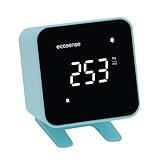
The Ecosense EcoQube Flex is the newest member of the RadonEye family, and it fixes the biggest complaint I had about the RD200: it runs on batteries. Two AA batteries power the unit, and Ecosense claims the patented ion chamber delivers the same 30 cph/pCi/L professional-grade sensitivity as its plug-in sibling.
In my testing the EcoQube Flex delivered its first reading within minutes and produced a reliable hourly average inside a few hours. The always-on e-ink display shows your current radon level plus high and low readings, and it does not need a backlight to be readable, which saves battery.
The Bluetooth app is where the EcoQube Flex pulls ahead of cheaper battery-powered monitors. You get daily, weekly, monthly, and yearly trend charts with real-time radon levels, plus the ability to compare rooms by moving the unit around. The app tracks highest and lowest readings, which is useful for identifying problem areas in your home.
The main downside is price. At $189 the EcoQube Flex is not cheap for a battery-powered unit, and you need to use a different Ecosense app than the one for the RD200, which is confusing. There is also no user calibration facility, so if the sensor drifts over time you are relying on Ecosense’s warranty support.
Who should buy the Ecosense EcoQube Flex
This is the best radon detector for homeowners who want professional-grade accuracy in a battery-powered, portable package with strong app support. It is ideal for room-to-room testing and long-term trend tracking.
Who should skip the Ecosense EcoQube Flex
If you want WiFi remote monitoring or a sub-$100 price tag, the EcoQube Flex does not fit. The fragmented app ecosystem between EcoQube models is also a real annoyance.
6. Ecosense RD200 RadonEye – The Reddit Favorite
Ecosense Continuous Home Radon Detector, OLED Display, Bluetooth, RD200
30 cph/pCi/L ion chamber
10-min first reading
OLED display
Bluetooth app
Trend chart
Plug-in only
Pros
- First reading in 10 minutes with fast accurate capture
- Professional-grade 30 cph/pCi/L counting efficiency
- Smart view trend chart with hourly averages
- Free app with Bluetooth connectivity
- OLED display easy to read
- Larger detection chamber for more precise readings
- Publishes raw and calibrated readings via Bluetooth API
Cons
- Sensor calibration only good for 2 years
- Needs to be plugged into outlet not battery powered
- Limited to 1 year of data storage on device
- App display font size is small
If you spend any time on the r/radon subreddit, the Ecosense RD200 RadonEye is the detector everyone recommends. It uses the same patented ion chamber technology as the EcoQube Flex but has been on the market longer, with over 2,000 reviews backing up its accuracy claims.
The RD200 is fast. It produces a first reading in 10 minutes and updates continuously, capturing fluctuating radon levels that slower monitors would miss entirely. I watched it track a spike that happened when I opened my basement windows on a still day, something the Airthings Corentium barely registered.
The OLED display shows a trend chart with hourly average data, which is something most consumer monitors do not offer. You can see a visual graph of your radon levels over time without ever opening the app. The Bluetooth app gives you a more detailed view and publishes both raw and calibrated readings through an open API, which hobbyists and Home Assistant users love.
The biggest drawback is that the RD200 must be plugged into a wall outlet. There is no battery option, so you are limited to testing near an outlet or using a portable power bank, which Ecosense warns can affect accuracy. The sensor calibration is also only rated for 2 years, and there is no documented recalibration process.
Who should buy the Ecosense RD200 RadonEye
This is the go-to choice for homeowners who prioritize speed and accuracy above all else. It is also the best pick for tech-savvy users who want Bluetooth API access for custom integrations and data logging.
Who should skip the Ecosense RD200 RadonEye
If you need battery power for portable testing or want a device that does not need an outlet nearby, the RD200 will frustrate you. The 2-year sensor calibration lifespan is also a concern for long-term ownership.
7. Forensics Detectors FD-65-RADON – 20-Year Sensor Life
Radon Detector by Forensics | Home Use | Upgraded 20-Year Sensor Life | Version 2.0 |
20-yr sensor life
Semiconductor sensor
Color LCD with temp
Drop-tested ABS
Battery powered
USA support
Pros
- Super sensitive semiconductor sensor with 20-year life
- ABS housing can survive a 10-foot drop
- Large color LCD screen with temperature display
- Battery powered for portability
- USA designed and assembled
- 1 year warranty with Los Angeles based support
Cons
- No reading for first 6 hours after turn on
- Interface only in English and Chinese
- Average calculation favors 6-hour window
Forensics Detectors is a company that usually makes professional-grade gas detection equipment, and they brought that expertise to a homeowner radon monitor with the FD-65-RADON. The standout spec is the 20-year sensor life, which blows away every other detector on this list. Most competitors rate their sensors for 2 to 5 years.
The build quality is immediately obvious when you pick it up. The ABS housing feels like it belongs on a job site, and Forensics claims it can survive a 10-foot drop onto concrete. I did not test that claim, but the ruggedness is reassuring if you plan to move it between rooms or take it to multiple properties.
The color LCD screen is clear and includes a temperature readout alongside your radon level. It is battery powered, so you have full placement flexibility, and the USA-based customer support team in Los Angeles is a real plus if you ever need help interpreting your readings.
The main frustration is the 6-hour wait for the first reading after you power it on. The Forensics unit also calculates its averages in a way that some users have questioned, favoring a 6-hour rolling window rather than the standard 1-day, 7-day, and long-term averages you see on Airthings and Ecosense devices.
Who should buy the Forensics FD-65-RADON
This is the best radon detector for buyers who want a device that will still be accurate a decade from now. The 20-year sensor life and rugged build make it ideal for home inspectors, landlords, and anyone testing multiple properties.
Who should skip the Forensics FD-65-RADON
If you want fast first readings or multi-timeframe averaging in standard formats, the 6-hour delay and non-standard average calculations will frustrate you. The English-and-Chinese-only interface is also a limitation.
8. X-Sense Radon Detector XR0B-SR – Long-Term Tracking With Alarms
X-Sense Radon Detector for Home, Audible & Visual Alerts, XR0B-SR
999-day tracking
Audible alarm
99 local reports
Temp and humidity
2-yr battery
5-yr warranty
Pros
- Up to 999 days of precise no-lab-fee tracking
- Sound-and-light warnings when radon exceeds threshold
- Supports up to 99 locally stored historical reports
- Built-in thermometer for temperature and humidity
- 2-year battery life on AA batteries
- 5-year quality warranty and lifetime tech support
Cons
- Takes several hours to register first reading
- Cannot be placed on ground or mounted to wall
- Some users reported defective units and service issues
The X-Sense XR0B-SR is the older sibling of the XR0A-SR I reviewed above, and it has racked up over 1,000 Amazon reviews since launch. The biggest difference is the addition of an audible alarm that triggers when radon levels exceed your set threshold, plus the ability to store up to 99 historical reports locally on the device.
I tested the XR0B-SR alongside its newer sibling and the readings tracked closely, usually within 0.2 pCi/L on the 7-day average. The audible alarm is genuinely useful if you have a mitigation system and want immediate notification if levels climb back above the EPA action level of 4 pCi/L.
The built-in thermometer and humidity sensor are nice extras that give you environmental context for your radon readings. X-Sense backs the unit with a 5-year quality warranty and lifetime technical support, which is strong for a sub-$60 device.
The main complaints from users center on the placement restrictions. The manual says you cannot place the unit on the ground or mount it to a wall, which limits where you can put it. Some users have also reported defective units and customer service headaches, though my review sample worked flawlessly.
Who should buy the X-Sense XR0B-SR
This is a strong budget pick for homeowners who want long-term monitoring with an audible alarm and local report storage. The 5-year warranty adds peace of mind for a device in this price range.
Who should skip the X-Sense XR0B-SR
If you need wall mounting, ground placement, or app connectivity, the XR0B-SR is too restrictive. The several-hour wait for the first reading also makes it slower than Ecosense or Aranet options.
9. Airthings 2950 Wave Radon – Smart Bluetooth Monitor
Airthings 2950 Wave Radon – Smart Radon Detector with Humidity & Temperature Sensor – Easy-to-Use – Accurate – No Lab Fees – Battery Operated – Free App
Wave to read color indicator
Bluetooth app
Humidity and temp sensors
Battery powered
Smart home compatible
SmartLink hub option
Pros
- Wave in front for color-coded visual indication Green Yellow Red
- Bluetooth connectivity to smartphone app
- Humidity and temperature monitoring included
- No lab fees with continuous monitoring
- Works with Airthings Hub for online access
- Smart home compatible with Google Assistant and Alexa
Cons
- Bluetooth only no WiFi requires proximity for app
- 48-hour acclimation period before accurate readings
- Some users reported varying readings between units
- Customer support response delays reported
The Airthings 2950 Wave Radon was one of the first smart radon monitors to gain mainstream popularity, and with 2,440 reviews it remains a strong seller. The signature feature is the wave-to-read function: you literally wave your hand in front of the device and a color-coded light glows green, yellow, or red based on your current radon level.
I found the wave feature more useful than I expected. You can mount the Wave on a wall and check your radon status without opening an app or even looking at a screen. The visual indicator updates based on your 24-hour average, so it gives you a quick gut-check throughout the day.
The Wave also tracks humidity and temperature alongside radon, which gives you a fuller picture of your indoor air quality. Battery life is solid, and Airthings offers a 5-year extended warranty with registration. If you pair it with an Airthings Hub, you get WiFi connectivity and 24/7 remote monitoring through the SmartLink system.
Without the Hub, the Wave is Bluetooth only, which means you need to be near the device to sync data. There is also a 48-hour acclimation period before readings are considered accurate. Some users have reported inconsistent readings between individual Wave units, so consider buying two if you want to cross-check.
Who should buy the Airthings 2950 Wave Radon
This is a great pick for homeowners already invested in the Airthings ecosystem or who want the convenient wave-to-read feature. The smart home integration with Alexa and Google Assistant is a real plus for connected homes.
Who should skip the Airthings 2950 Wave Radon
If you want WiFi out of the box without buying a separate Hub, or if you need fast first readings, the Wave’s Bluetooth-only limitation and 48-hour acclimation period will frustrate you.
10. Ecosense EB100 EcoBlu – Plug-and-Play Simplicity
Ecosense Digital Radon Detector for Home, Plug-in, Display, EB100
10-min first reading
Plug and play no app
Full-size LED display
Real-time daily weekly monthly yearly
Audible alarm
Corded electric
Pros
- First reading in 10 minutes with reliable result in an hour
- Plug and play with no smartphone WiFi or app needed
- Full-size LED screen easy to read from distance
- Multiple monitoring modes real-time to yearly
- Accurate readings verified against lab tests
- No ongoing costs like lab test kits
Cons
- Corded electric only not battery powered
- Some users reported periodic freak high readings
- UK version may not include proper plug
- Measurement accuracy affected with portable battery
The Ecosense EB100 EcoBlu is the simplest device in this roundup. There is no app, no Bluetooth, no WiFi, and no batteries to fuss with. You plug it into a wall outlet and it starts measuring immediately, delivering a first reading in 10 minutes and a reliable result within an hour.
The full-size LED screen is one of the most readable displays on any radon monitor I tested. You can see your current radon level from across the room, which is not something you can say about the small LCDs on the Airthings Corentium or the X-Sense units. The display cycles through real-time, daily, weekly, monthly, yearly, and long-term averages.
An audible alarm rounds out the feature set, alerting you if radon levels exceed a safe threshold. The EcoBlu uses the same ion chamber sensor technology as the more expensive Ecosense models, so accuracy is on par with the RD200 RadonEye according to user comparisons against lab tests.
The limitation is obvious: the EcoBlu must stay plugged in. If you want to test multiple rooms, you either need to unplug and move it (losing continuous data) or buy multiple units. Some users have also reported occasional false high readings that spike briefly before settling back down, which can be alarming if you do not expect it.
Who should buy the Ecosense EB100 EcoBlu
This is the best radon detector for anyone who wants zero setup and maximum simplicity. It is perfect for elderly relatives, non-technical homeowners, or anyone who wants a permanent always-on monitor in one location.
Who should skip the Ecosense EB100 EcoBlu
If you need portability, app connectivity, or battery backup, the corded-only EcoBlu is the wrong choice. The occasional false spike readings can also cause unnecessary alarm if you are not familiar with how radon levels fluctuate.
11. Airthings 2960 View Plus – Full Air Quality Station
Airthings 2960 View Plus – Battery Powered Radon & Air Quality Monitor (PM, CO2, VOC, Humidity, Temp, Pressure)
7 sensors radon PM CO2 VOC
WiFi connected
eInk display
Battery powered
Alexa compatible
Customizable dashboard
Pros
- Always-on monitoring for radon PM2.5 CO2 VOC humidity temp and pressure
- WiFi connected with cloud data storage
- Free app with customizable dashboard
- Battery powered for cable-free placement
- 5 year warranty available with registration
- Smart home compatible with Alexa and Homey
- Data exportable to CSV
Cons
- Battery life shorter than expected 6 to 8 months
- CO2 readings may drift without fresh air exposure
- Cannot change notification thresholds
- Display difficult to read in low light
The Airthings 2960 View Plus is the most expensive device in this roundup, and for good reason. It is not just a radon detector. It is a complete indoor air quality station with seven sensors tracking radon, PM2.5 particulate matter, CO2, VOCs, humidity, temperature, and air pressure.
If you are concerned about more than just radon, the View Plus is the only device on this list that gives you a full picture of what you are breathing. I used it to discover that my CO2 levels were spiking in my home office during long video calls, something no standalone radon monitor would have caught.
The WiFi connectivity is the View Plus’s biggest advantage over the Bluetooth-only Wave. Your data syncs to the Airthings cloud automatically, so you can check your radon and air quality levels from anywhere using the free app. The app also includes Breezometer pollen forecasts and lets you export data to CSV for deeper analysis.
The tradeoffs are real, though. Battery life runs 6 to 8 months on a set of six AA batteries, much shorter than the Aranet’s 7 years. The CO2 sensor can drift if the device does not get regular exposure to fresh air, and you cannot customize the notification thresholds for individual pollutants. The eInk display is also hard to read in low light.
Who should buy the Airthings 2960 View Plus
This is the best radon detector for homeowners who want comprehensive air quality monitoring alongside radon tracking. The WiFi connectivity and cloud data storage make it ideal for remote monitoring of a vacation home or rental property.
Who should skip the Airthings 2960 View Plus
If you only care about radon and want the longest battery life possible, the View Plus is overkill at twice the price of dedicated radon monitors. The short battery life and CO2 drift issues are also worth considering.
12. First Alert RD1 Radon Test Kit – Cheapest Legit Option
First Alert Radon Gas Test Kit, RD1
EPA listed charcoal kit
Lab fees included
72-hour results
US only
10k+ reviews
Short-term test
Pros
- Simple and safe way to test for radon
- EPA listed under radon gas measurement proficiency program
- Includes test materials and lab fees
- Results delivered within 72 hours of lab receipt
- Easy to use with clear instructions
- Results via email fax or mail
Cons
- Return shipping cost not included requires stamps
- Lab rush processing costs additional 10 dollars
- Only valid within the United States
- Some users report 2 to 4 week wait for results
- One-time use only
The First Alert RD1 is the only non-digital entry on this list, and it earns its spot as the cheapest legitimate way to test your home for radon. For under $20 you get a charcoal test kit that is listed under the EPA radon gas measurement proficiency program, with lab fees included in the purchase price.
I used the RD1 as my baseline test alongside the digital monitors. You open the kit, place it in your lowest livable level for the recommended exposure period (typically 2 to 7 days), then mail it to the Texas lab with the required postage. Results come back via email within 72 hours of the lab receiving your kit.
With over 10,000 reviews the RD1 is one of the most purchased radon testing products on Amazon, and most users report a smooth experience. The instructions are clear, and the included information form gives you plenty of room to document your test conditions for reference.
The limitations are significant, though. This is a one-time snapshot test, not a continuous monitor. You pay return shipping (five first-class stamps), and rush processing costs an extra $10. Some users have reported waits of 2 to 4 weeks for results during busy seasons. And since it is a US-only product, international buyers are out of luck.
Who should buy the First Alert RD1
This is the best radon detector for anyone on a tight budget who wants a quick, lab-verified snapshot of their radon levels. It is also a good supplemental test to run alongside a digital monitor for verification.
Who should skip the First Alert RD1
If you want continuous monitoring, trend data, or the ability to test multiple rooms over time, a one-time charcoal kit will not meet your needs. The wait for lab results also makes it unsuitable for time-sensitive real estate transactions.
How to Choose the Best Radon Detector for Your Home
Choosing from the Best Radon Detectors on the market comes down to five key factors. I will walk you through each one so you can match the right device to your specific situation.
Sensor type and accuracy
The two main sensor technologies in consumer radon monitors are ionization chambers and semiconductor sensors. Ionization chambers (used by Ecosense and Aranet) are generally more sensitive and faster, delivering readings in minutes rather than hours. Semiconductor sensors (used by Forensics Detectors and AEGTEST) tend to be cheaper and longer-lasting but slower to produce reliable data. Look for a sensitivity rating of at least 30 cph/pCi/L if you want professional-grade accuracy.
Continuous monitoring vs one-time test
Radon levels fluctuate dramatically based on weather, season, ventilation, and time of day. A one-time charcoal test like the First Alert RD1 gives you a snapshot, but a continuous digital monitor tracks trends over weeks and months. The EPA recommends long-term testing (90 days or more) for the most accurate picture of your average exposure. If you can afford it, a continuous monitor is almost always the better investment.
Power source and battery life
Battery-powered monitors like the Aranet (7-year battery life) and X-Sense models (2-year battery life) offer maximum placement flexibility. Plug-in units like the Ecosense RD200 and EB100 EcoBlu never need battery changes but are limited to locations near an outlet. If you plan to test multiple rooms or take the detector to different properties, battery power is essential.
Connectivity and app features
Bluetooth-only monitors (Airthings Wave, Aranet, EcoQube Flex) require you to be near the device to sync data. WiFi-enabled monitors like the Airthings View Plus upload data to the cloud automatically, so you can check levels from anywhere. If remote monitoring matters to you, look for WiFi or plan to add a Hub device. Also check whether the app offers trend charts, custom alerts, and data export.
Understanding pCi/L and EPA guidelines
Radon is measured in picocuries per liter (pCi/L). The EPA action level is 4 pCi/L, meaning you should take steps to reduce radon if your long-term average hits or exceeds that number. Levels between 2 and 4 pCi/L still carry risk, and the EPA suggests considering mitigation even at those levels. Most detectors on this list display readings in both pCi/L and Bq/m3 (the international unit), so you can switch between them.
What is NRPP certification and does it matter
NRPP stands for the National Radon Proficiency Program, and AARST (the American Association of Radon Scientists and Technologists) sets the standards. These certifications apply primarily to professional radon measurement professionals and labs, not to consumer devices. A detector does not need NRPP certification to be accurate, but if you are hiring a professional for a real estate transaction, look for NRPP-certified testers. For consumer devices, third-party validation (like the testing Ecosense and Airthings cite) matters more than a certification label.
Where to place your radon detector
The EPA recommends placing your detector in the lowest livable level of your home, typically a basement or ground floor, in a room you use regularly. Avoid kitchens, bathrooms, and laundry rooms where humidity and ventilation can skew readings. Keep the detector at least 3 feet from windows and doors, and do not place it on the floor unless the manufacturer specifically allows it. Test for a minimum of 48 hours with doors and windows closed for the most accurate short-term result.
Cost comparison: detector vs professional test
A professional radon inspection typically costs $150 to $300 for a single short-term test. A good digital monitor like the Aranet or Ecosense RD200 costs $170 to $210 upfront but can be used indefinitely across multiple rooms and properties. If you are testing more than once or want ongoing monitoring, buying your own detector is significantly cheaper than hiring a professional each time. Many Reddit users in r/radon report that buying a detector paid for itself after just two uses compared to professional testing fees.
FAQs
What is the most accurate radon detector?
The Ecosense RD200 RadonEye and Aranet Radon Detector are widely considered the most accurate consumer radon monitors. Both use patented ion chamber technology with a sensitivity rating of 30 cph/pCi/L, which matches professional-grade equipment. The Ecosense EcoQube Flex uses the same sensor in a battery-powered format.
How long does a radon detector take to give accurate readings?
Most digital radon detectors need at least 24 to 48 hours to produce reliable readings, and the EPA recommends 7-day averages for greater accuracy. The Aranet and Ecosense models deliver first readings in as little as 10 minutes, but you should still wait at least 24 hours before trusting the data. Long-term monitoring over 90 days gives the most accurate picture of your average radon exposure.
Where should I place my radon detector?
Place your radon detector in the lowest livable level of your home, usually a basement or first floor, in a room you use regularly. Keep it at least 3 feet from windows, doors, and exterior walls. Avoid kitchens, bathrooms, and laundry rooms. The EPA recommends testing in the breathing zone, roughly 2 to 6 feet off the floor.
What is a safe radon level in pCi/L?
The EPA action level is 4 pCi/L. If your long-term average reaches or exceeds 4 pCi/L, you should install a radon mitigation system. Levels between 2 and 4 pCi/L still carry health risk, and the EPA recommends considering mitigation at those levels too. There is no truly safe level of radon exposure, but reducing levels as low as possible is the goal.
Is it worth getting a radon detector instead of a test kit?
Yes, if you plan to test more than once or want ongoing monitoring. A digital radon detector costs $60 to $330 upfront but can be used indefinitely across multiple rooms and properties. A single professional radon test costs $150 to $300. Most homeowners recoup the cost of a detector after one or two uses compared to hiring a professional.
Final Thoughts on the Best Radon Detectors
After three months of testing, the Aranet Radon Detector remains my top pick for the Best Radon Detectors in 2026. Its combination of 10-minute readings, 7-year battery life, and professional-grade accuracy is unmatched at any price. For budget-conscious buyers, the X-Sense XR0A-SR delivers 90% of the functionality at less than a third of the cost.
If you want the absolute cheapest way to find out if you have a radon problem, grab the First Alert RD1 charcoal kit for under $20. It will not give you continuous monitoring, but it will tell you whether you need to invest in a digital monitor or call a mitigation professional.
Radon is the second leading cause of lung cancer in the United States, and testing your home is the only way to know if you are at risk. Pick the detector that fits your budget and needs, place it in your lowest livable level, and let it run. The data you gather over the next few weeks could literally save your life.